LTCG shadow looms large over Tata group's plan to reduce cross-holdings

Group companies, excluding Tata Sons, hold nearly Rs 214.6 billion worth of shares in other listed firms
graph
graph
Krishna KantDev Chatterjee Mumbai
Last Updated : Feb 05 2018 | 1:24 AM IST
The long-term capital gains (LTCG) tax, proposed in the Union Budget 2018-19, will make it costly for the Tata group to consolidate promoter holdings in various listed companies owned by Tata Sons, the group’s holding company, from the next financial year, 2018-19. 

However, the Tata group has a window till March 31 to complete this exercise without coming into the tax net. 

Various group companies, excluding Tata Sons, held shares worth nearly Rs 214.6 billion in other listed Tata companies at the end of December last year. After this Budget, group companies will have to pay the 10 per cent LTCG tax on gains on their equity investments in other group companies if they sell their stakes to Tata Sons. 

This change in taxation will affect promoters of all companies wishing to reduce cross-holdings or change ownership within the promoter group. 

Tata Sons, however, can consolidate the cross-holdings by the end of March this year without incurring any LTCG tax. “Any sale of listed shares on the market till March 31 will not attract the LTCG tax. Given there is grandfathering of unrealised appreciation in prices till January 31, and hence a cost base step-up to that extent, if share prices do not increase early in the next financial year, the delta of capital gains will be limited,” said Ketan Dalal, managing partner, Katalyst Advisors LLP.

Tata Sons is raising funds from both local and international sources, mainly to subscribe to the Tata Steel rights issue and repay telecom loans. “Tata Sons will be on a deadline to buy out the shares of other Tata listed companies. With the grandfathering clause, it makes sense for the Tatas to wait rather than go on a buying spree and complete the exercise by March-end,” said a partner of a leading audit firm.

Under its new Chairman N Chandrasekaran, Tata Sons has been buying out the Tata group’s listed companies’ stakes from other listed firms in the past year.

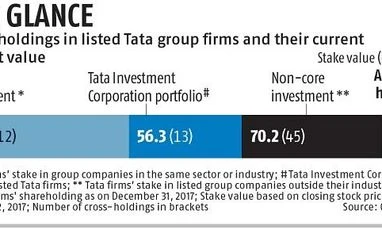
The analysis is based on the Tata group listed companies’ shareholding pattern at the end of December 2017. The cross-holdings of group companies are part of the promoter holding of respective companies. The value of the equity stake is based on the share price of respective companies as on February 2, 2017. At the end of March 2017, 19 Tata companies, excluding Tata Sons, had cross-holdings in 26 listed group companies. Among individual group companies, Tata Investment Corporation has the biggest portfolio, with equity stakes in 13 listed group companies worth Rs 56.3 billion at their current stock prices, followed by Tata Steel, which had equity stakes in nine listed group companies, currently valued at Rs 42.3 billion.

Other group companies with large equity investments in other Tata group companies include Tata Chemicals (Rs 39 billion), Tata Power (Rs 10.5 billion), Tata Motors (Rs 7 billion), and Indian Hotels (Rs 2.2 billion).

Analysts also said Tata companies would not be selling all their cross-holdings to parent Tata Sons as many of these were strategic investments in subsidiaries or associates with operations in the same industry. For example, Tata Steel is the promoter and owner of companies such as Tinplate Company, Tata Metaliks, Tayo Rolls, Tata Sponge Iron, which complement its iron and steel business. Tata Sons owns no stakes in these companies. 

Similarly, Tata Chemicals is the controlling shareholder of agrochemical player Rallis India that complements its agri-inputs business. Indian Hotels is a co-promoter of Benares Hotels and Oriental Hotels along with other non-Tata promoters.

There is also lack of clarity on the fate of Tata Investment Corporation equity investments in other group companies. “Tata Investment Corporation is a pure-play investment company that buys small stakes in listed firms, including Tata companies, as part of its investment activity. If Tata Sons buys its stakes in other group companies, this shrinks its investment option in the market,” said a market expert.

Excluding Tata Investment Corporation investments and Tata companies’ stakes in subsidiaries and associates in the same industry, nearly Rs 70.1 billion worth of equity stakes are held by group companies in other listed companies. 

These include Tata Industries’ stake in Tata Motors (Rs 30.4 billion), Tata Chemicals stake in Titan Company (Rs 11.4 billion), Tata Chemicals stake in Tata Steel (Rs 2 billion), Tata Motors stake in Tata Steel (Rs 3.5 billion), Tata Power’s stakes in Tata Communications (Rs 8.3 billion), and Tata Chemicals stakes in Indian Hotels (Rs 1.4 billion).

In September last year, Tata Sons had reduced cross-holdings by buying stakes in Tata Chemicals and Tata Global Beverages from group companies to the tune of Rs 16 billion.


One subscription. Two world-class reads.

Already subscribed? Log in

Subscribe to read the full story →
*Subscribe to Business Standard digital and get complimentary access to The New York Times

Smart Quarterly

₹900

3 Months

₹300/Month

SAVE 25%

Smart Essential

₹2,700

1 Year

₹225/Month

SAVE 46%
*Complimentary New York Times access for the 2nd year will be given after 12 months

Super Saver

₹3,900

2 Years

₹162/Month

Subscribe

Renews automatically, cancel anytime

Here’s what’s included in our digital subscription plans

Exclusive premium stories online

  • Over 30 premium stories daily, handpicked by our editors

Complimentary Access to The New York Times

  • News, Games, Cooking, Audio, Wirecutter & The Athletic

Business Standard Epaper

  • Digital replica of our daily newspaper — with options to read, save, and share

Curated Newsletters

  • Insights on markets, finance, politics, tech, and more delivered to your inbox

Market Analysis & Investment Insights

  • In-depth market analysis & insights with access to The Smart Investor

Archives

  • Repository of articles and publications dating back to 1997

Ad-free Reading

  • Uninterrupted reading experience with no advertisements

Seamless Access Across All Devices

  • Access Business Standard across devices — mobile, tablet, or PC, via web or app

Next Story



