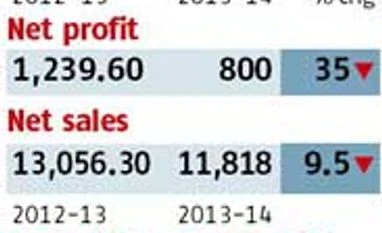
The slump in demand, higher expenses and dealer compensations took a toll on Maruti Suzuki, with the company’s net profit for the quarter ended March falling 35.4 per cent to Rs 800 crore. For the corresponding quarter last year, the company had reported a net profit of Rs 1,240 crore. The two figures, however, are not strictly comparable, as the year-ago period’s profit included the full impact of the merger of Suzuki Powertrain.
For 2013-14, Maruti’s volumes declined 1.4 per cent to 1,155,041 units, largely led by a decline in exports. Domestic volumes were flat year-on-year. By comparison, the sector reported a six per cent decline in volumes, the first such decline in about a decade.
In a call with analysts, Maruti said in 2013-14, its exports declined 15.6 per cent to 101,352 units on account of political unrest in some countries and regulatory concerns in others. Maruti is focusing on the African and West Asian markets, as are many of its competitors such as Mahindra & Mahindra, Tata Motors and Hyundai.
During the March quarter, volumes dropped five per cent to 324,870 units; domestic volumes fell three per cent to 298,596 units. At Rs 11,818 crore, net sales fell nine per cent.
Volumes are, however, expected to pick up this year, as the company has lined up at least three new launches in the domestic market. It had recently launched the Celerio, recording 35,000 bookings for the model so far.
Though volumes and revenue growth remained weak, Maruti’s margins rose through 2013-14 due to localisation and improved efficiencies. In the March quarter, however, the company’s operating margin declined from 12 per cent levels to 10.3 per cent due to payout to dealers to compensate for excise duty cuts. The company took a hit of Rs 143 crore due to stock compensation to dealers, said Chairman R C Bhargava.
The excise duty reduction announced in the 2014-15 interim Budget was passed on to customers immediately, though dealers had already paid higher excise.
“The earnings before interest, tax, depreciation and amortisation (Ebitda) margin for the quarter was way below estimate at 10.3 per cent, against our expectation and consensus of 12.5 per cent. At Rs 12,500 crore, the reported Ebitda was 19 per cent below estimate,” read an Emkay report.
The decline in margins isn’t expected to continue. While localisation and lack of one-time payouts will have a beneficial impact on margins, rising competition from Hyundai’s Grand i10 and Xcent, Honda’s Amaze and Datsun’s GO has forced Maruti to step up sales promotion. Higher promotional spends tend to impact margins. The company says with competition, such expenses might rise in the coming quarters.
Bhargava said, “We are waiting for the election results (May 16). We are hoping after a new government comes to power, there will be a revival in the car market…in consumer sentiment…There should be easing of pressure in the coming months, but there won’t be dramatic growth.”
Maruti’s cash reserves stand at Rs 8,800 crore and it hopes to add Rs 1,000 crore this year. Senior executives said the reserves would be utilised for product development, marketing and supporting costs for manufacturing plants abroad.
Maruti’s board has recommended a 50 per cent rise in dividend pay — from Rs 8 a share to Rs 12. Dividend of about Rs 203 crore will be paid to Suzuki Motor Corporation, the controlling company, against Rs 135 crore (calculated at Rs 8 a share).
The company has changed some terms of the plan for its investors who favour in-house production. As a result, Suzuki might invest an additional Rs 3,000 crore, Bhargava said. The company will have a discussion with minority shareholders in August-September.

 "Maruti net slips 35%, misses estimates")


 Connect with us on WhatsApp