Nano, India’s cheapest car, manufactured by Tata Motors, appears to be a key friction area between the former Tata group chairman Cyrus Mistry and Ratan Tata, who returned as interim chairman last month. However, the car in its current form might not survive beyond three years as the country moves towards stringent safety and crash-test norms.
The government has made it mandatory for all existing car models to meet the crash-test norms and have air bags and anti-lock braking system (ABS) from October 2019. New models will have to meet crash-test norms from October 2017, while air bags and ABS become mandatory from October 2018 for new models.
Nano will have to undergo a significant structural re-engineering and need additional investments if it has to meet these norms. While these improvements look possible, it will put a further question mark on the product’s viability. Since Nano has always remained a loss-making product, the pressure of recovering any additional investment could push up the prices and render it uncompetitive vis-a-vis peers. After his exit, Mistry had claimed the product was consistently losing money, peaking at Rs 1,000 crore and added the only turnaround strategy can be through stopping Nano’s production.
“It will be a challenge to maintain an attractive price differential between Nano and other small cars if all safety norms are met. It will be a difficult proposition to sustain sales and grow,” said Abdul Majeed, partner at Price Waterhouse and an auto expert.
Launched in 2009, Nano’s volume has been under pressure in recent years in spite of more than one re-launch. The last re-launch happened in the middle of 2015. From a peak annual volume of over 74,000 units in FY12, Nano sales are down to 21,000 units in FY16. It continues to lose market. Entry of new competition in the form of Renault Kwid and Nissan’s redi-GO has created new challenges for the product.
The Nano is priced at Rs 2.19 lakh (ex-showroom) and goes up to Rs 3.15 lakh. Its nearest competitor in terms of price, redi-GO from Nissan, begins at Rs 2.42 lakh and goes up to Rs 3.49 lakh. Two variants, priced at Rs 3.37 lakh and Rs 3.49 lakh, have an air bag. The Nano runs on a 600cc engine while all other entry-level cars mostly sport a more powerful 800cc engine. Maruti Suzuki’s Alto800 has air bag in models priced at Rs 2.89 lakh and Rs 3.15 lakh.
Responding to queries, a Tata Motors spokesperson said, “While we continue to work towards developing variants that meet more stringent crash test protocols, we look forward to working with regulators for an evolutionary, progressive regime, balancing the affordability and vehicle safety, pedestrian safety, good road-user behaviour and robust active safety features.” The firm is learnt to be working on a new-generation Nano, which will address concerns on safety and other mandatory norms. It could replace the current Nano. Guenter Butschek, chief executive and managing director, said about two months ago the firm would be phasing out certain vehicles (both passenger and commercial) without divulging details.
In slow lane

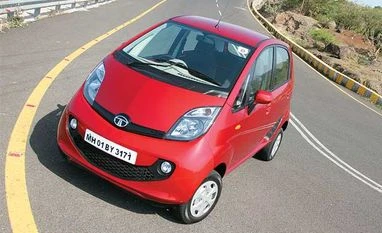 "Can the Nano survive beyond 2019?")


 Connect with us on WhatsApp