No end to Jet Airways' free fall: Will the airline go Kingfisher's way?

Jet has been in restructuring mode for the past 5 years with no signs of a turnaround
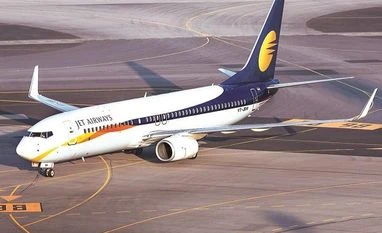
Jet's unit costs increased 8.7 per cent while its unit revenue declined 3.9 per cent
Jet’s unit costs increased 8.7 per cent while its unit revenue declined 3.9 per cent
Anjuli Bhargava New Delhi
Last Updated : Oct 29 2018 | 9:26 PM IST
With its second-quarter loss expected to exceed Rs 20 billion and the total outstanding payment to vendors and suppliers estimated in the range of Rs 120 billion to Rs 80 billion sitting on its books, Jet Airways' present situation looks grimmer than ever. In fact, the Centre for Asia Pacific Aviation's (CAPA's) September 2018 report on the Indian aviation scenario estimates that Jet will end this financial year with a loss of around of $500 million (Rs 31.5 billion).    

A Jet spokesperson denied the outstanding payment figure, saying that it was "grossly incorrect", but refused to divulge the actual number when questioned by Business Standard. However, industry sources maintained that the total liabilities of the airline might be even higher.

Given the airline's woes, the staff are jittery. Several senior pilots and cabin crew said that they were looking out for options. Pilots also said that they had told the management that they would stop flying after Diwali if some semblance of order was not brought into the way the airline was being run. As on October 27, the pilots received 25 per cent of their previous month's salary. 

Pilots said that every month they were constantly worried about whether they would receive their salaries. "Flying is a stressful job as it is, and this cliff-hanger situation every month is not helping matters," said a senior pilot.  

ALSO READ: Jet Airways defaults on lease rentals, receives notice from AAI on dues

A senior aviation analyst felt that there was little difference between Jet's current predicament and Kingfisher's situation a few years back. "Jet Airways is already on life support," he said, adding that when companies struggle to pay salaries and meet daily expenses, they have gone beyond the "vendor and lender stage".  

Industry veteran and former pilot Shakti Lumba put it pithily: "Naresh Goyal will have to either let go or let Jet go." He added that the airline needs a much flatter management structure and needs to get rid of many vice-presidents and senior vice-presidents. 

Industry analysts compared Jet's situation to the one that SpiceJet found itself in four years ago. But sources pointed out that there were at least four other significant factors working against Jet.  


First, the political winds are not in its favour. Jet's founder-chairman Naresh Goyal is not known to be close to the Modi government and had many more friends in the Congress. But that aside, whatever official sympathy there was for Jet Airways' plight seems to be waning. While initially, nobody wanted to see the airline go under during the tenure of the Modi government, the line of thinking now seems to be that the government cannot be expected to rescue a sinking private ship. "The government has Air India to worry about," explained a source.

Second, unlike in 2014 when Ajay Singh stepped in to rescue SpiceJet, the external environment is not favourable. Oil prices are on the rise and the rupee has weakened vis-a-vis the dollar. The adverse impact of this can be seen on the balance sheet of all airlines, including the best and the biggest. Last week, IndiGo, too, announced a Rs 6.53 billion loss for the second quarter.

Third, will Goyal be willing to do what Kalanidhi Maran did in 2014 for SpiceJet? In other words, hand over his airline to someone for free to fix. "In a similar scenario in 2014, Singh took over all of SpiceJet's losses and liabilities but did not pay a rupee, or rather, he paid just one rupee. The question is, will Goyal agree to exit on similar terms," asks an industry source.


Fourth, in the past few months, Jet's credit rating and market capitalisation have taken a severe beating. Industry sources said they could not think of anyone who would be ready to take on Jet's liabilities, which far exceed the airline's market capitalisation. "The airline's total outstanding and the amount needed to bring some semblance of normalcy in its operations is estimated at 10 times its current market cap. I don't see anyone willing to invest that kind of money in the present environment," an analyst said. 

Above all, sources pointed out that while SpiceJet had a structure that was "viable", Jet Airways' was largely "unviable" in an aviation environment where few fliers were willing to pay a premium for a full-service carrier. Kapil Kaul, CEO of CAPA, said, "Jet Airways has been in restructuring mode for the last five years, but with little results. Despite improved productivity and a cut in non-fuel cost, a financial turnaround has remained elusive." 

A rumour was going around last week that the Tatas could be interested in picking up a share in Jet. A senior government source was of the view that the Tatas could be interested in Jet's domestic and international market as it could give its own carrier Vistara a ready entry into them and a quicker path for growth. Jet's domestic and international market shares are around 15 per cent and 13-14 per cent, respectively. However, many argue that valuation would be a sticking point. 


Industry sources said that under the circumstances, Goyal's options were quite limited. Jet's present partner Etihad is not willing to offer any more lines of credit or invest any further in the airline. Goyal can try and convince someone else to invest in the carrier, but once again, the question is, at what price. Unless he manages to pull some sort of a last-minute rabbit out of his hat, for the first time in the airline's 25-year history, a Jet Airways without Goyal is looking increasingly likely.    

One subscription. Two world-class reads.

Already subscribed? Log in

Subscribe to read the full story →
*Subscribe to Business Standard digital and get complimentary access to The New York Times

Smart Quarterly

₹900

3 Months

₹300/Month

SAVE 25%

Smart Essential

₹2,700

1 Year

₹225/Month

SAVE 46%
*Complimentary New York Times access for the 2nd year will be given after 12 months

Super Saver

₹3,900

2 Years

₹162/Month

Subscribe

Renews automatically, cancel anytime

Here’s what’s included in our digital subscription plans

Exclusive premium stories online

  • Over 30 premium stories daily, handpicked by our editors

Complimentary Access to The New York Times

  • News, Games, Cooking, Audio, Wirecutter & The Athletic

Business Standard Epaper

  • Digital replica of our daily newspaper — with options to read, save, and share

Curated Newsletters

  • Insights on markets, finance, politics, tech, and more delivered to your inbox

Market Analysis & Investment Insights

  • In-depth market analysis & insights with access to The Smart Investor

Archives

  • Repository of articles and publications dating back to 1997

Ad-free Reading

  • Uninterrupted reading experience with no advertisements

Seamless Access Across All Devices

  • Access Business Standard across devices — mobile, tablet, or PC, via web or app

Next Story


