5 min read Last Updated : Oct 26 2020 | 12:51 AM IST
Ride-hailing firm Ola is witnessing a huge recovery for its newly formed food business amid the coronavirus (Covid-19) pandemic. The recovery comes on the back of the gradual unlocking of the economy as restaurants open up for business and fears of catching the virus from delivered food recede.
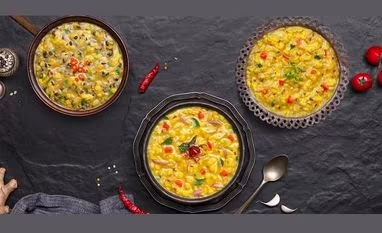
The SoftBank-backed company said that its flagship food brand ‘Khichdi Experiment’ has clocked over 1 million orders in less than a year despite the Covid-19 pandemic.
“It has become one of the fastest-growing brands on all platforms,” said Pranay Jivrajka, chief executive officer (CEO) at Ola Foods. “We have been able to create Khichdi as a new category and have 80 per cent of the market share in the segment,” he said.
Ola Foods, which was launched in 2019, has expanded to a network of over 50 technology-enabled kitchens. These are present across 6 cities in the country. These include Bengaluru, Mumbai, Delhi, Chennai, Pune and Hyderabad.
Ola has three in-house brands, Khichdi Experiment, Paratha Experiment and Bowlsome. The company is working on many other brands.
“Through our network of kitchens at Ola Foods we want to rapidly build consumer- first food brands in every market,” said Jivrajka.
Over a span of one year, the firm aims to build a portfolio of 8 -10 brands across a network of 150-200 kitchens. The focus is to expand its presence across India and build a portfolio of brands in other categories such as Biryani, pizza and health. Some of these brands have already been launched across select markets. The firm would be scaling them in the next few months.
The relevance of cloud kitchens is increasing manifold, especially amid the pandemic. They are enabling restaurants to plug supply gaps at a micro-market level and helping them scale rapidly which was not possible due to high real estate costs.
Ola said it covers 35-40 per cent of food delivery customers. It plans to expand its coverage to serve 75-80 per cent of the urban food delivery demand. “Our immediate goal is to expand our network of cloud kitchens so as to serve more customers,” said Jivrajka.
As people embrace the new normal, Ola is seeing a distinct change in consumer behaviour. There is a growing trend of cooking at home which includes DIY (do-it-yourself) cooking kits. Consumers are also increasingly opting for takeaways thereby leading to the rise of cloud kitchens that offer restaurant-like food which can be consumed at the comfort and safety of home.
“We feel these changes are going to act as a tailwind for the industry to grow in the long run and create a lot more opportunities in the future,” said Jivrajka.
According to industry data, the overall food services industry is projected to grow from $60 billion in 2018- 19 to $90 billion by 2023. Food delivery is poised to grow to $15 billion in the next three years with market share growing from 6 per cent to 15 per cent.
Ola plans to expand its coverage to serve 75-80 per cent of the urban food delivery demand.
Ola is betting big on technology to tap this opportunity. It has set up a research and development and food innovation centre. It has created a strong culinary team of chefs, food technologists, automation specialists, and nutritionists to innovate and create differentiated products.
The firm follows a multi-brand kitchen model through which all the kitchens in the network are equipped to service various brands. The operational model is designed in such a way that each kitchen can service 8 - 10 brands and have the capability to scale up operations basis the requirement.
Ola is investing heavily in innovative ‘precision cooking’ methodologies by increasing automation in various aspects of food preparation. This ensures each dish is cooked at the right temperature and for the right amount of time to ensure food consistency. The firm is also working with partners to monitor kitchen quality processes through artificial intelligence-driven imaging solutions and connected kitchen equipment and devices to enable further automation and personalization of food. “We also believe that contactless delivery through drones would be the next frontier of logistics and we are excited about it,” said Jivrajka.
After initial hiccups due to the pandemic, food delivery giants Swiggy and Zomato are witnessing huge business recovery. Swiggy’s pan-India food delivery has recovered to around 80-85 per cent of pre-Covid-19 order value. Zomato’s food delivery volumes have also touched pre-Covid-19 peaks.
Analysts said the Indian Premier League (IPL) and its promotions in the form of campaigns and engagements have also definitely strengthened the food volumes. Due to the event, food delivery volumes are seeing a jump and food tech companies are capitalising on that demand,
Highlights:
Ola Foods’ brand ‘Khichdi Experiment’ crosses over 1 million orders.
The business has expanded to a network of over 50 technology-enabled kitchens in 6 cities.
It aims to build a portfolio of 8 -10 brands across a network of 150-200 kitchens.
Food services industry is projected to grow from $60 billion in 2018- 19 to $90 billion by 2023.
Ola has set up a research and development and food innovation centre.
Swiggy’s pan-India food delivery has recovered to around 80-85% of pre-Covid-19 order value.
Zomato’s food delivery volumes have touched pre-Covid-19 peaks.