ONGC plans to use Tapti assets for Daman field
Assets comprise Tapti gas processing platform, gas gathering stations and sub-sea pipelines
Sudheer Pal Singh New Delhi This article has been modified. Please see clarification at the end. State-run Oil and Natural Gas Corporation (ONGC) is planning to use its Tapti assets in the western offshore to advance production of gas and condensate from its neighbouring Daman field, under a Rs 5,219-crore plan.
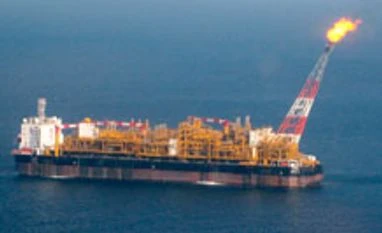
The assets comprise the Tapti gas processing platform, gas gathering stations and sub-sea pipelines.
ONGC holds 40 per cent stake in the Panna-Mukta and Tapti fields; Reliance Industries (RIL) and BG India hold 30 per cent each. However, with the Tapti output declining rapidly, the three partners have decided to end the joint venture (JV), the production sharing contract for which expires in 2019.
| ONGC'S DAMAN SPINNER |
- ONGC holds 40% stake in the Panna-Mukta and Tapti fields
- RIL and BG India hold 30% stake each in the fields
- With output declining rapidly, the partners have decided to exit the fields
- ONGC will take over the fields from its joint venture partners
- It will lay a small pipeline from the Daman field to the Tapti process platform
|
ONGC will take over the fields from the other two. It will lay a small pipeline from the Daman field to the Tapti process platform, connected by a 70-km pipeline to its facility at Hazira. Under a strategy to focus on small and less difficult fields to fill the production void due to delays in development of large assets like KG-D5, ONGC is investing Rs 5,219 crore in Daman.
“There have been a few technical issues in the handing over and the taking over of the facilities. The issues are now over and the process of taking over will begin July onwards. In Daman, we are developing seven wellhead platforms. Three of these will be ready to pump gas by July. These will be connected to the Tapti Process Platform,” said a senior ONGC executive. He added the first output of gas, 2.3 million standard cubic metres a day (mscmd) will start flowing from the three Daman platforms by July and the next four will start operating in 2016, taking the production to 8.2 mscmd.
Gas production from the Tapti fields dropped to half or 14.2 billion cubic feet (bcf) last financial year, even as oil production slumped a little over 20 per cent to 0.2 million barrels.
ONGC will take over the Tapti Part-A facilities, along with the abandonment obligation; the joint venture will be responsible for the abandonment obligation for Part-B facilities. The obligation includes dismantling the infrastructure set up for production.
Panna-Mukta, 90 km northwest of Mumbai, is primarily an oil-bearing field. Its oil production was flat at 7.2 million barrels, as gas production rose eight per cent to 70 bcf. The JV will continue to operate the Panna-Mukta field, likely to be in operation till 2018-19. Tapti is primarily a gas-bearing field, 160 km northwest of Mumbai. Its gas output is expected to fall to zero by the end of the current financial year. The Daman Development Project, 100 km from the Daman coast, includes additional development of the C-24 fields and monetisation of the B-12 marginal fields. The company is likely to produce a cumulative 27.6 billion cubic metres of gas and five million cubic metres of condensate over two decades to 2035. These will be routed to the Hazira facility through the Tapti processing assets.
The Daman development plan, coming after the announcement of a Rs 5,813-crore Mumbai High South Redevelopment Project (Phase-3) a few months earlier, signifies ONGC’s aggressive investment push in the western offshore basin to turn around output growth, which had grown only marginally in 2014-15.
CLARIFICATION
An earlier version of this article erroneously mentioned that BP holds 30% stake in Panna-Mukta and Tapti fields. The company that holds the said stake is BG India. The error is regretted. 
 "ONGC plans to use Tapti assets for Daman field")


