Portfolio concentration weighs on Bandhan Bank, stock down 13% post results

Dependence on microfinance loans for growth is steadily increasing, which poses a risk in present environment
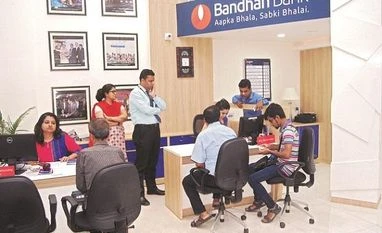
Bandhan Bank
While collection efficiency improved from 89 per cent in September to 92 per cent in December, it fell to 90 per cent in January for the MFI loans
Hamsini Karthik Mumbai
3 min read Last Updated : Jan 23 2021 | 1:12 AM IST
Bandhan Bank’s dominance in eastern India helped it bring in retail deposits (80 per cent of total deposits) and augment the share of its low-cost current account savings account (CASA) deposits to 43 per cent in the December quarter (Q3). 

However, its stock has lost about 13 per cent in two session after it announced its results, because its growing dependence on microfinance institution (MFI) loans is doing more harm than good at this juncture. 

Proforma gross non-performing assets (NPA) ratio — or NPAs unadjusted for the Supreme Court’s stay on bad loan recognition — rose to 7.1 per cent in Q3, the highest since its listing in 2018. Provisioning cost ballooned from Rs 295 crore last year to Rs 1,069 crore in Q3 (Rs 395 crore in Q2), indicating a stark deterioration in asset quality. 

According to the bank, 76 per cent of its loan book is less than 30 days past due (DPD), five per cent within 30-60 DPD, and 10 per cent in the 60-90 DPD bulge. 


Analysts at Kotak Institutional Equities note that about 24 per cent of its MFI book falls in the overdue category. The recent Assam MFI Act is not only hurting the bank’s collection efficiency, but also denting its financials. Net profit in Q3 declined by 13.5 per cent year-on-year (YoY) because of the Assam-related stress. 

Absence of an encouraging trend in collection efficiencies is another worry. 

While collection efficiency improved from 89 per cent in September to 92 per cent in December, it fell to 90 per cent in January for MFI loans.  

Even in Bandhan’s critical market of West Bengal, analysts at Motilal Oswal Financial Services note that as consumer demand has not yet revived fully, collection efficiency has also not returned to normal. 

Under these circumstances, the bank’s continued focus on the MFI space isn’t comforting. In Q3, advances grew by 22.6 per cent, while MFI advances grew by 32 per cent. Other segments, predominantly the mortgage book through Gruh Finance’s acquisition, grew by only seven per cent. Share of MFI loans has risen to 66 per cent in Q3 from 61 per cent a year-ago. The mortgage book has been a laggard. 

By 2025, the bank is planning to reduce dependence on MFI loans to 30 per cent and increase focus on mortgage loans to 30 per cent, though the current trend isn’t reflecting that. After Q3 results, analysts have sharply cut their earnings estimates by 7-11 per cent due to near-term stress in MFI loans. 

Therefore, to win back Street’s confidence, it’s important for the bank to grow beyond its comfort zone.

One subscription. Two world-class reads.

Already subscribed? Log in

Subscribe to read the full story →
*Subscribe to Business Standard digital and get complimentary access to The New York Times

Smart Quarterly

₹900

3 Months

₹300/Month

SAVE 25%

Smart Essential

₹2,700

1 Year

₹225/Month

SAVE 46%
*Complimentary New York Times access for the 2nd year will be given after 12 months

Super Saver

₹3,900

2 Years

₹162/Month

Subscribe

Renews automatically, cancel anytime

Here’s what’s included in our digital subscription plans

Exclusive premium stories online

  • Over 30 premium stories daily, handpicked by our editors

Complimentary Access to The New York Times

  • News, Games, Cooking, Audio, Wirecutter & The Athletic

Business Standard Epaper

  • Digital replica of our daily newspaper — with options to read, save, and share

Curated Newsletters

  • Insights on markets, finance, politics, tech, and more delivered to your inbox

Market Analysis & Investment Insights

  • In-depth market analysis & insights with access to The Smart Investor

Archives

  • Repository of articles and publications dating back to 1997

Ad-free Reading

  • Uninterrupted reading experience with no advertisements

Seamless Access Across All Devices

  • Access Business Standard across devices — mobile, tablet, or PC, via web or app

Topics :Bandhan BankMarkets

Next Story



