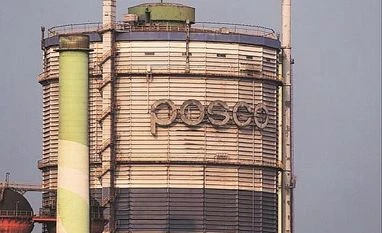
It’s another day of hope for South Korean steel major POSCO as it takes yet one more shot at setting up a new steel plant in India. In the past 17 years, it has tried alone and in partnership with private and public sector companies to get a meaningful foothold in the market, but without success. As it joins forces with Adani, one of India’s most powerful business groups, the big question everyone’s asking is whether POSCO will be fifth-time lucky.
On January 13, in a statement, the Adani group and POSCO said they had signed a non-binding agreement to explore business cooperation opportunities, including setting up a green, environment-friendly integrated steel mill at Mundra, Gujarat. The investment outlay is pegged at around $5 billion.
The partnership brings together the world’s most competitive steelmaker and India’s leading integrated infrastructure player, including in renewables, throwing up possibilities of multiple synergies.
“POSCO will be able to leverage Adani’s ports and energy business in the state and set up a large steel mill in India, putting it among the forefront of steelmakers investing in green steel technology in India,” said Isha Chaudhary, director, CRISIL Research.
The steel industry contributes between 7 and 9 per cent to global emissions, and players across the world are setting goals for reducing their carbon footprint. POSCO has committed to be carbon neutral by 2050.
Though details regarding technology and plant configuration are yet to be spelt out, according to the scope of the agreement, POSCO and Adani also intend to collaborate at the “group business level” in various industries such as renewable energy, hydrogen and logistics in response to carbon reduction requirements.
And, the west coast offers proximity to energy sources like hydrogen and renewable power. The collaboration has its advantages but the entry of a new player may seem like an ambitious plan.
The steel industry as it stands in India is largely dominated by six steel producers — JSW Steel, Tata Steel, ArcelorMittal Nippon Steel India, Jindal Steel & Power, Steel Authority of India Ltd and Rashtriya Ispat Nigam Ltd. Together, they account for about 63 per cent of crude steel production, and their share has been rising.
Further, the private sector producers are upping their game and looking to grow at a frenetic pace on the back of a strong steel cycle that has seen prices touch record levels in the past two years. About 24 million tonnes are expected to be added by the top four private producers in the next three years and plans are already being drawn up for the decade.
“A $5-billion investment in greenfield for a new player in India looks brave,” said Vivek Kamra, managing director, Alvarez & Marsal.
Why brave? “A high cost of initial investment and cyclicality make steel a high-stakes game. Now the new variable is how emissions and carbon taxes will impact steel companies. Keeping these factors in mind, what technology the Adani-POSCO plant ultimately settles for will be keenly watched,” he explained.
But Kamra also pointed out that POSCO has under its belt the expertise of setting up one of the world’s most efficient port-based plants.
It’s early days. Sources point out that the two sides would now start studying the prospects of business cooperation.
Still, the agreement immediately signals a significant development on two counts: It symbolises Adani’s interest in the steel space and underlines POSCO’s keenness to get a beachhead in a growing market.
POSCO’s India journey has been riddled with challenges, the most famous being its 12-million tonne plant in Jagatsinghpur district in Odisha that got mired in protests against land acquisition. The company had signed an MoU in 2005 for a $12- billion steel plant, but till 2013, the state government managed to transfer only part of the land.
The final blow, however, was a change in mining laws by the Centre in 2015, which made it mandatory for companies to go through the auction route for captive mines as opposed to allotment on a nomination basis. The same year POSCO suspended its project in Odisha for lack of progress.
But POSCO kept at it. When it failed to make any headway in Odisha, it signed a memorandum of association with the Miglani family-controlled Shree Uttam Steel and Power in 2015 for a much smaller plant of three million tonnes. But then, the Uttam group ran into problems and that, too, did not progress.
Between 2010 and 2011, it had also considered setting up a plant with public sector steel major Steel Authority of India Ltd (SAIL) at Bokaro but that did not take off over differences over shareholding structure. Its most recent prospective partnership was with state-owned RINL (with which it signed an agreement in 2019) but that got dashed as the Centre decided to privatise the public sector undertaking. And there were others who were tapped by the company for tie-up.
But POSCO does have a presence in India in the form of a downstream unit — a 1.8-million tonne cold-rolled and galvanised mill — though the plan always was to have an upstream unit. Yet, even as the global steel major sought out partnerships to set up new plants, it stayed away from acquisitions in India.
Five stressed steel assets — from the Reserve Bank of India’s first list of non-performing assets — totalling about 21 million tonnes of capacity were auctioned under India’s insolvency law in 2018. It opened a floodgate of opportunities for existing and new players.
ArcelorMittal — which, like POSCO, was derailed in Odisha from setting up a mega-steel plant — finally got a base in India by acquiring Essar Steel jointly with Nippon Steel (it had signed the agreement a year after Posco); Vedanta entered the steel sector with the acquisition of Electrosteel Steels; Tata Steel and JSW Steel got bigger with their respective acquisitions of Bhushan Steel and Bhushan Power & Steel.
But in all the cases, India’s nascent insolvency law, rolled out in 2016, was put to the test in courts —some more famously than others. POSCO also steered clear of participating in the privatisation process for Neelachal Ispat Nigam Ltd.
Local issues can be tricky to deal with for foreign companies, pointed out sources. And few companies know that better than POSCO. But a partnership with a powerhouse like Adani may be its best chance of dealing with the pain points of doing business in India.