Divya Deshpande is out for her Diwali shopping, albeit with mask and hand sanitiser in tow. But her shopping destination isn't the nearest mall in Goregaon or Malad, both suburbs in Mumbai. Instead, she heads to a marketplace in Andheri, closer to her home in Santacruz. She claims it is safe, comfortable, and easy to walk into a high-street store than a mall.
Deshpande isn't the only one feeling this way. A recent study by the Retailers of Association of India (RAI), the apex body of organised retailers in the country, said after the online channel, which has the highest preference in terms of festive shopping this year, consumers are opting for standalone stores or high-street outlets for their Diwali shopping rather than malls. The preference rate for standalone shops stands at 66 per cent versus malls, which is 37 per cent. While e-commerce has a preference rate of 75 per cent, the RAI noted. Retailers confirm the trend, saying that high-streets have been doing better business for them than malls, since the Unlock programme began in June.
"We've seen a quicker recovery (of sales) at high-street stores than shopping centres and malls," Abhishek Ganguly, managing director (MD), Puma India and Southeast Asia, said on Wednesday at a virtual summit organised by the Federation of Indian Chambers of Commerce and Industry.
At the same summit, Lalit Agarwal, chairman and MD, V-Mart Retail, noted consumers remained largely fearful of going to large shopping destinations, choosing to restrict themselves to neighbourhood and standalone stores.
Footfall at high-street stores is at 60-70 per cent of last year's level, say retail industry executives. In contrast, footfall at malls is at 30-40 per cent, though mall operators say the trend is improving with Diwali nearing.
"Sequentially, we are seeing an improvement in footfall and sales over the last few weeks and this trend should continue over the next fortnight and beyond," said Rajneesh Mahajan, chief executive officer (CEO), Inorbit Malls (India). Inorbit has properties in Mumbai, Navi Mumbai, Vadodara, Bengaluru, and Hyderabad.
Mahajan said tier-I city malls have been slower to recover versus tier-II city malls, where the fear among consumers of catching the virus is less. "Mumbai malls opened only in August and it has taken time for consumers to warm up to shopping in malls again. However, we see it getting better over time," he said.
Mukesh Kumar, CEO, Infiniti Mall, which has two properties in Malad and Andheri in Mumbai, said shopping trips have been fewer by consumers, but basket values have been higher.
"The footfall is lower than pre-Covid levels. That is true. But the conversion rate is higher versus pre-Covid. It was 30 per cent earlier, now the conversion rate is as much as 70 per cent. In other words, the people walking into malls are serious buyers, who are opting to pick up things in one go," he said.
Mall operators admit that shopping as an experience has come down because of Covid-19 and that it would take time for consumers to revert to their pre-pandemic behaviour.

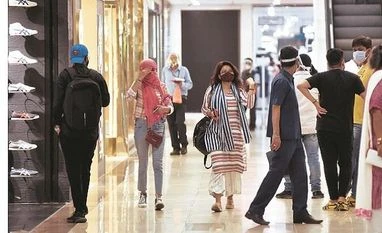 "Safe & comfortable: High street scores higher with shoppers than malls")











