McDonald's India dilemma: Growing in South but facing closure in North

McDonald's is growing in south, west India but losing ground in north, east amid internal squabbles
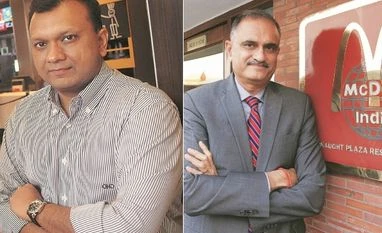
McDonalds, Mc d,
McDonald's entered India via two partners, Amit Jatia (left) and Vikram Bakshi. In 2013, Bakshi was removed as managing director of the fast food chain
Surajeet Das Gupta New Delhi
Last Updated : Aug 21 2017 | 4:38 PM IST
This article first appeared in Business Standard on 26.07.2017. We are republishing this article in light of McDonald's announcing the termination of the franchise agreement between its India arm McDonald’s India Private Limited (MIPL) and Vikram Bakshi headed Connaught Plaza Restaurants Ltd (CPRL) on 21/08/2017.

Amit Jatia’s appetite for growth seems endless. The promoter and vice-chairman of Westlife Development, the franchisee for McDonald’s in west and south India, has added 86 outlets in the last three financial years, and is set to open 25 stores this year. 
 
But the story is dramatically different for Vikram Bakshi. Over the past four years, a bitter battle with McDonald’s, his joint venture partner in Connaught Plaza Restaurants Pvt Ltd (CPRL) that runs the outlets in north and east India for the fast food chain, has taken a toll on his business. He has added only 16 new chains over the past three years, against a target of 135. 

The situation is even more dire this year. Only one new outlet was added and, in a new twist, CPRL was forced to close 53 stores in the National Capital Region because of failure to renew eating house licences. 

Bakshi, who is at loggerheads with McDonald’s, has refused to sign the renewal documents. To renew it, the JV partner and a McDonald’s-nominated director need to co-sign the application. As the impasse continues, the company is losing a cool Rs 20 crore a month. 
 
“We have incurred a loss of over Rs 500 crore in the last three and half years,” says Bakshi. If CRPL had grown as planned, McDonald’s in India would have surpassed Domino’s Pizza by revenue. 

Till 2012, McDonald’s was the leader in the consumer food services business, lording it over everyone else with 19 per cent market share. But the no-holds-barred battle between the JV partners set it back by years, creating opportunities for Domino’s Pizza to race ahead. The revenue gap between the two is widening, according to data from Euromonitor, which tracks the sector. Even at the number two spot, Coffee Cafe Day is snapping at it heels. 

McDonald’s problems couldn’t have surfaced at a worse time. Cut-throat competition, rapid expansion and a slowdown in consumer spending in the wake of demonetisation have seriously dented the overall quick-service restaurant business. One estimate puts the number of outlets that shut down over the past 18 months at 100. The big boys are reeling too. Jubilant Foodworks was forced to trim the number of Dunkin Donut outlets by 13 to 63, and same store growth for Domino’s Pizza fell 2.4 per cent in 2016-17.


At the heart of the current problems at McDonald’s lies Bakshi’s removal from the post of managing director in 2013, a decision that he is contesting at various legal forums. However, a resolution appears in sight. Last week, the National Company Law Tribunal in a judgment reinstated Bakshi as the managing director of CPRL and appointed an administrator with a casting vote on board decisions. 

Bakshi says he is waiting for a board meeting to be convened so that the issue of licence can be quickly resolved (it would require board approval). McDonald’s, however, is still mulling whether it should appeal against the decision in the appellate authority. McDonald’s declined to comment on the matter.   

The most important issue on the agenda for the administrator is for the two partners to put their signature on the dotted line to renew the licence. If they don’t, the administrator has the casting vote to force the two parties to do so.  At the same time, concerns over quality of food at Mac stores raised by Bakshi have to be addressed, and the partners have to come to a settlement on the price at which Bakshi is ready to sell out his stake in the JV. 

The good news for McDonald’s is that its business in the west and south is in fine fettle despite the slowdown. Jatia says same store sales in his company went up 4 per cent in FY17 (far better than 1.8 per cent the previous year). But there is no denying that demonetisation has taken its toll —for Westlife, same store revenue increased only 1 per cent in the fourth quarter of FY 2017 (compared to 8. 4 per cent the previous quarter). Yet Jatia pushed overall revenues by 5 per cent by opening 16 more stores in the last quarter.

Jatia has innovated across the spectrum — bringing in new services, revamping the menu and reducing the calorie content in burgers, among others. One such innovation has been the introduction of McCafé, a separate station for freshly-made coffee in 111 outlets, with the aim to extend it to 30-40 more stores this year. He has also introduced five “experience of the future” outlets, which offer table service, self-ordering kiosks with a menu consisting of soups, whole wheat wraps and masala eggs. 

“What we are doing is to provide a new experience to consumers and even experiment on making the products healthier,” says Jatia. But he  says people are not eating out as much as he would like. In Mumbai, for example, people went out to eat thrice a month in 2012. The frequency increased to eight times in 2013, but has remained at 9-10 times since, he says. 

Adding to McDonald’s worries is the entry of Burger King which also sells a similar menu. The company, which entered the market just two years ago, has been expanding quietly across the country. With 100 outlets already, Burger King could prove to be a strong challenge in the future, says Bakshi. 
 
McDonald’s needs to quickly resolve its old battles to fight new ones.

One subscription. Two world-class reads.

Already subscribed? Log in

Subscribe to read the full story →
*Subscribe to Business Standard digital and get complimentary access to The New York Times

Smart Quarterly

₹900

3 Months

₹300/Month

SAVE 25%

Smart Essential

₹2,700

1 Year

₹225/Month

SAVE 46%
*Complimentary New York Times access for the 2nd year will be given after 12 months

Super Saver

₹3,900

2 Years

₹162/Month

Subscribe

Renews automatically, cancel anytime

Here’s what’s included in our digital subscription plans

Exclusive premium stories online

  • Over 30 premium stories daily, handpicked by our editors

Complimentary Access to The New York Times

  • News, Games, Cooking, Audio, Wirecutter & The Athletic

Business Standard Epaper

  • Digital replica of our daily newspaper — with options to read, save, and share

Curated Newsletters

  • Insights on markets, finance, politics, tech, and more delivered to your inbox

Market Analysis & Investment Insights

  • In-depth market analysis & insights with access to The Smart Investor

Archives

  • Repository of articles and publications dating back to 1997

Ad-free Reading

  • Uninterrupted reading experience with no advertisements

Seamless Access Across All Devices

  • Access Business Standard across devices — mobile, tablet, or PC, via web or app

Next Story



