Home / Companies / News / Uber spreading wings in India by rolling out attractive offers
Uber spreading wings in India by rolling out attractive offers
The world's leading start-up is burning cash to build a network of cars and loyal customers in India
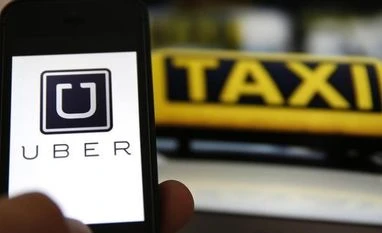
An illustration picture shows the logo of car-sharing service app Uber on a smartphone next to the picture of an official German taxi sign in Frankfurt
Uber, the cab aggregator service, is aiming to capture the transportation market in key Indian cities by offering schemes to both riders and drivers.
Backed by marquee investors such as Goldman Sachs and Google, the mobile app-based taxi service provider is encouraging car owners and passengers towards it platform by providing offers, though this also means burning hoards of cash.
India is its second-biggest market in terms of geographical presence. Uber, estimated to be worth $40 billion, is offering a ‘double referral bonus’, where an existing user gets rides up to Rs 600 for onboarding every new member. The first ride for the new member is also free for up to Rs 600.
To ensure enough supply of cars to meet the demand created through this referral scheme, it is also providing drivers with per-trip bonuses. Uber is offering a temporary incentive scheme, of Rs 100-275 per trip to car owners, irrespective of trip fare. This has helped Uber meet the twin objective of getting more cars on to its platform and ensuring these stay on the road for a long while. Car owners enrolled in Uber said they target at least 10 rides a day to make the most of the incentive scheme.
“India is one of our global priority markets… The growth we are seeing in general in India is truly spectacular,” said Shailesh Sawlani, general manager.
A metric which signals that the company has been able to build a strong car network within a year of starting operations in the country is ‘car availability time’. For instance, though the fleet of cars empanelled with Uber is “nowhere close to” the 50,000-taxi network in this city, the amount of time required to get a car through the Uber app is almost similar to getting a traditional cab.
“When we started a year ago, the waiting time for getting a car was about 25 minutes. Today, it is down to eight minutes,” said Sawlani.
Uber’s real test will be in ensuring it is able to sustain the growth and demand even after withdrawing its incentive schemes. The company hinted it might scale back its incentive schemes after it sees natural organic growth and achieves the required demand and supply.
Their revenue model involves charging 20 per cent commissions on every bill generated through its platform. It is not in a hurry to break even, as long as the growth is robust. The kind of growth the company is seeing in India is currently the highest in the world, it says.
Uber is present in 300 cities globally and in 11 cities in India, the most in any country outside its home market of America. Delhi, Mumbai, Bengaluru and Kolkata are the top cities in terms of business for the company.

 "Uber spreading wings in India by rolling out attractive offers")


 Connect with us on WhatsApp