Having once deemed cow slaughter a capital crime, earlier this month the party of Prime Minister Narendra Modi passed a law in the northern state of Haryana that makes the act punishable by only up to 10 years in prison.
That law, along with a similar one recently passed in Maharashtra, brings to 20, out of 29 states in India that completely ban cow slaughter. This, however, is a not-so-simple majority: Although the population of India is 80 per cent Hindu and so largely non-beef eating, the beef ban's advances have sparked considerable debate and confusion. You see, India is the second-largest exporter of beef in the world after Brazil.
During last year's national election campaign, Modi attacked the ruling Congress government for the "pink revolution" in India's beef exports. Yet since he has come to power, beef exports have increased - by almost 17 per cent in April-November 2014 compared with a year before - even as his party has cracked down on domestic beef consumption. Modi gestures at traditional bucolic virtues to mask an aggressive agenda of export-led development.
Trying to unravel these conundrums, I set out last week to talk to a few people I thought would care about the Cow Question.
Surprise. S K Swami, the vegetarian Hindu founder of the Love4Cow Trust, a network of so-called cow-protection activists, had no strong feelings about the burgeoning beef exports. "There's a confusion about the categorisation of cattle," he explained. "We work to promote the economic and scientific virtues of Indian cows. We don't work for buffaloes or anything else."
He meant that the 1.89 million metric tons of beef India exported in 2012-2013 were derived largely from herds of the native water buffalo Bubalus bubalis. This beast is beef, according to the United States Department of Agriculture and the global meat industry, but in India it is known as "buff" and doesn't count as forbidden flesh. The new laws apply only to Indian cows and bulls, mostly of the Bos taurus indicus subspecies, and possibly imported meats of the Bos taurus species. The law, as they say, is an ass (subgenus Asinus).
I also went to see Chiraguddin Qureshi, the Muslim owner of the Taj Mahal Meat Shop in the city's historic Nizamuddin quarter, where a friend of mine buys veal for his signature Kerala beef fry. Again, surprise. It's a common presumption in India that the country's substantial Muslim minority (over 13 per cent of the population) are the primary consumers of beef. Yet Qureshi said, over the syncopated clatter of two men chopping meat on tree stumps, that quite a few of his customers, like my friend the Kerala beef fry cook, are Hindus.
After all, there are those few beef-tolerant states, and some nominally Hindu communities and individuals with a taste for beef. Then there is economics: One consequence of the general taboo is that bovine flesh is often one of the cheaper forms of protein around, and a staple for many underprivileged communities. Cattle are still valued as a source of manure and draught power, and are left to reproduce freely at pasture. Restrictions on slaughter mean that herds in India are not culled as in countries with regulated beef industries, contributing to a large surplus of animals, particularly older males. In shops in Delhi, adult buff costs a ~180 a kilo, compared with ~420 for goat.
Perversely, this market mechanism is just what has driven the boom in buffalo exports and substantial cattle smuggling (including of cows) to Bangladesh: Foreign prices are much higher than local prices. "Since this government came to power, 80 new slaughterhouses have been built in Uttar Pradesh alone," Qureshi said of the Modi administration. "And it's all for export."
Which is why - another surprise - this butcher wants the beef-export business banned: Only exporters can afford to snap up the better stock. He said he longed for the "tender pink beef of our childhood," and the buffaloes of Punjab and Haryana.
Swami, of the Love4Cow Trust, also bemoaned the loss of antique native breeds of milch cows to the modernization of dairy production and "the fad of crossbreeding with Jersey and Holstein lines." "It's hard to find a pure Indian herd today," he said, lamenting the Sahiwal and the Gir, and other endangered lineages of indigenous cattle.
Later that evening, as I watched a talk-show debate titled "Beef and the 'Bone' of Contention," some of these charming contradictions seemed to curdle into harsher ironies. It was a typical televised carnival of adversarial inanities, sententious sermons and barefaced untruths. And it was possibly more representative of the national temper than my own conversations.
©2015 The New York Times News Service

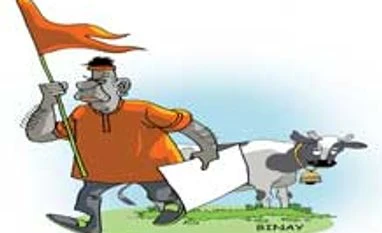 "A country that only feels for its cows")


 Connect with us on WhatsApp