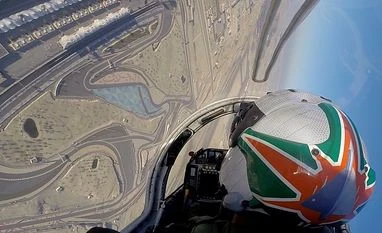
In a milestone for India’s Tejas light-combat aircraft (LCA), two Tejas fighters travelled from India to performed aerobatics at the Bahrain International Air Show (BIAS-2016) from January 21-23. Business Standard has obtained the first official account of this first international outing, where the Tejas impressed global aerospace experts, taking an important first step towards export in the future.
This official account comes from the Indian Air Force (IAF), which is overseeing the flight test programme of the Tejas; and from the Aeronautical Development Agency (ADA), the defence research & development (R&D) organisation responsible for the Tejas programme.
The proposal for this outing was initiated by the Kingdom of Bahrain, which invited the defence ministry in September 2015, to display the Tejas in BIAS-2016. Defence Minister Manohar Parrikar quickly gave the go-ahead for the Tejas, and also the Embraer-mounted Airborne Early Warning System (AEWS), to travel to Bahrain.
It required a major organisational effort to get two Tejas fighters, three pilots and a fully equipped maintenance team from Hindustan Aeronautics Ltd (HAL) to Bahrain. Only then could the Tejas display its “Made-for Bahrain” aerobatics, showcasing its performance in vertical climbs, tight turns, high-speed runs and slow flying ability.
The IAF detailed one of its giant C-17 Globemaster IIIs to transport the maintenance team and equipment to Bahrain. Two Tejas fighters flew three legs, over three days — the first from Bengaluru to Jamnagar in Gujarat (1,800 km); the second to Muscat (1,200 km), and the final leg to Bahrain (850 km).
The Indian Navy supported the flight over the Arabian Sea. The pilots were provided sea survival training at the new water survival training facility at Kochi. During the flights between Jamnagar and Muscat, the Navy kept one P8-I maritime aircraft airborne throughout, in case a rescue was needed.
Says Commodore (Retired) C D Balaji, who heads ADA: “The Bahraini authorities made us extremely welcome. Their minister for transportation personally came to the airport to receive the Tejas fighters when they flew in. The King of Bahrain came to our stall during the exhibition. We gifted him a model of the Tejas.”
Balaji confirms that the Pakistani light fighter, the JF-17 Thunder, was to come to Bahrain but pulled out at the last minute — it has been speculated that the Pakistan Air Force (PAF) realised it would be overshadowed by the Tejas.
“We don’t know why Pakistan pulled out the JF-17. But, yes, it was scheduled to be at Bahrain. Its parking slot, which was next to ours, was eventually occupied by the Eurofighter,” says Balaji.
The Tejas’ flight displays went off flawlessly, with pilots from the National Flight Test Centre in Bengaluru, having put together a special “product demonstration” performance, which showcased for potential customers the operational performance that makes it a combat-worthy fighter — such as the ability to climb quickly and turn tightly.
The IAF, which is traditionally measured in its evaluation of the Tejas, says the fighter’s “control harmony is comparable to the best in the world… The intuitive cockpit layout and highly reliable life support systems provide for comfort as well as excellent situational awareness.”
Authoritatively detailing the Tejas’ performance parameters, the IAF says: “The LCA has a very competitive and cotemporary operational envelope. It is capable of operations up to an altitude of 50,000 feet and a maximum speed of 1.6 Mach at [high] altitudes or 730 knots… at low levels. The aircraft [can turn at] +8G to -2.5G (which allows it to U-turn in 350 metres) in operationally clean configuration… or +6G to -2.5G with other external stores.”
The IAF sums up: “The LCA Mark 1 was designed as a worthy indigenous replacement to the MiG fleet that has been the backbone of the defence of our skies for several decades. It is a safe and contemporary design with a reliable and efficient engine and many modern features. The aircraft is cockpit friendly, agile and easy to fly. It is this capability that was displayed in the recently concluded Bahrain International Air Show… Serial production of the aircraft by HAL has started and it is expected that fighter will be operationally inducted by IAF in 2016.”

 "Air force, DRDO, pleased with Tejas performance at Bahrain")


 Connect with us on WhatsApp