Annular Solar Eclipse 2020: How, when and where to watch the phenomenon

This time, ARIES will live telecast the solar eclipse. Those interested, can watch the eclipse on YouTube, Zoom and Facebook
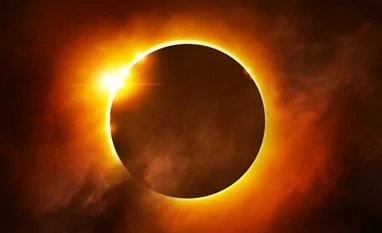
Annular Solar eclipse
Annular Solar eclipse. Photo: Shutterstock
BS Web Team New Delhi
2 min read Last Updated : Jun 19 2020 | 12:58 PM IST
The first solar eclipse or Surya Grahan of 2020 will fall on June 21. This will be an annular solar eclipse where moon will cover the sun from the centre leaving the outer rim visible, thus creating a ring of fire. The annular solar eclipse of June 2020 will start at 9:15 am on June 21 according to Indian Standard Timing (IST). The full eclipse will start from 10:17 am with the maximum eclipse occurring at 12:10 pm. Aryabhatta Research Institute of Observational Sciences (ARIES), Nainital, an autonomous institute of the Department of Science & Technology (DST) will live telecast the eclipse. “Astronomical events such as eclipse are exceptional opportunities to excite and instruct the youth and indeed the society at large about science and to instill scientific temper,” said Professor Ashutosh Sharma, Secretary, DST.

Where will the solar eclipse be observed?

The solar eclipse will be observed from the parts of Africa, Asia, and some parts of Europe, and the peak eclipse will be observed in the northern part of India starting at 10:25 am with maximum eclipse at 12:08 pm and ending at 01:54 pm.

How to watch solar eclipse on June 21?

The best way to safely watch a total solar eclipse is to wear protective eclipse glasses or to project an image of the eclipsed Sun using a pinhole projector.

This time, ARIES will live telecast the solar eclipse. Those interested, can watch the eclipse via YouTube, Zoom and Facebook.

Solar eclipse time in India

The annular solar eclipse will state at 9:15 am. In north India, it will start at 10:25 am, with maximum eclipse at 12:08 pm. The solar eclipse will end at 1:54 pm.

Is it unsafe to watch solar eclipse?

Never look directly at the Sun, eclipsed or otherwise, without any protective eyewear. The Sun’s UV radiation can burn the retinas in your eyes leading to their permanent damage or even blindness.

Wear protective eclipse glasses.

One subscription. Two world-class reads.

Already subscribed? Log in

Subscribe to read the full story →
*Subscribe to Business Standard digital and get complimentary access to The New York Times

Smart Quarterly

₹900

3 Months

₹300/Month

SAVE 25%

Smart Essential

₹2,700

1 Year

₹225/Month

SAVE 46%
*Complimentary New York Times access for the 2nd year will be given after 12 months

Super Saver

₹3,900

2 Years

₹162/Month

Subscribe

Renews automatically, cancel anytime

Here’s what’s included in our digital subscription plans

Exclusive premium stories online

  • Over 30 premium stories daily, handpicked by our editors

Complimentary Access to The New York Times

  • News, Games, Cooking, Audio, Wirecutter & The Athletic

Business Standard Epaper

  • Digital replica of our daily newspaper — with options to read, save, and share

Curated Newsletters

  • Insights on markets, finance, politics, tech, and more delivered to your inbox

Market Analysis & Investment Insights

  • In-depth market analysis & insights with access to The Smart Investor

Archives

  • Repository of articles and publications dating back to 1997

Ad-free Reading

  • Uninterrupted reading experience with no advertisements

Seamless Access Across All Devices

  • Access Business Standard across devices — mobile, tablet, or PC, via web or app

Topics :Solar EclipseScienceastronomySun

Next Story



