At COP27, India supports early warning systems on climate impacts

Environment minister Bhupender Yadav says country 'making swift progress' in building such systems
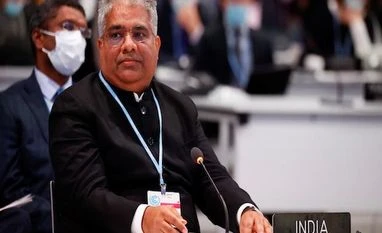
India's Environment Minister Bhupender Yadav attends the UN Climate Change Conference (COP26) in Glasgow (Photo: Reuters)
India's Environment Minister Bhupender Yadav attends the UN Climate Change Conference
Nitin Kumar New Delhi
3 min read Last Updated : Nov 08 2022 | 8:25 PM IST
Climate finance for developing nations is a mirage and adapting measures such as early warning about extreme weather events will save lives, said India’s environment minister Bhupender Yadav at the UN’s annual climate-change summit in Egypt on Tuesday.

“Early warnings for all play a part in not just containing the immediate physical impacts, but also mitigating the far-reaching long-term socio-economics implications that follow,” Yadav said.

India leads the Coalition for Disaster Resilient Infrastructure (CDRI), an international organisation developing applications for climate forecast and early warning for reducing infrastructure loss and disruption in basic services.

CDRI at the 27th session of the Conference of the Parties (COP27) will pitch a proposal to support the climate-change adaptation projects by island nations on November 17. The initiative follows the launch of Infrastructure Resilient Island States (IRIS) last year which supports the 58 small island developing States (SIDS) in achieving sustainable development “through a systematic approach to resilient, sustainable, and inclusive infrastructure.”

Also read: COP27: 112 nations pledge to protect 30% of land and ocean by 2030

“We would be interested in supporting the island states through our three core activities--capacity building, knowledge sharing and technical assistance. The program would look at early warning systems, nature-based solutions, climate resilient infrastructure among others. Most of it is adaptation focus and the agenda also is to build on our work to get additional finance for climate resilient infrastructure,” said Amit Prothi, director general, CDRI told this paper recently.

CDRI is a partnership of national governments, UN agencies, multilateral development banks and financing mechanisms, the private sector, and knowledge institutions to promote the resilience of infrastructure systems for climate and disaster risks in support of sustainable development. It was launched by PM Narendra Modi in 2019 at the UN Secretary-General’s Climate Action Summit in New York, United States.

India is working to strengthen early warning systems for all hydro-meteorological hazards and this has reduced the impact on human life, said Yadav at the UN Secretary General High Level Round Table to launch the 'Early Warnings for All Executive Action Plan'.

“We have reduced mortality from cyclones by up to 90 per cent over the last 15 years. On both east and west coasts, we have nearly 100 per cent coverage of early warning systems for cyclones. Similarly, for other hazards — such as heat waves — we are making swift progress, leading to much greater resilience of our communities,” Yadav said.

Yadav said the India Meteorological Department’s Cyclone Warning Division (CWD) acts as a multilateral Regional Specialised Meteorological Centre for monitoring, predicting and issuing warning services on tropical cyclones developing over the north Indian Ocean. It works along with 13 countries in the Bay of Bengal and Arabian Sea region.

The collaboration helped in the exchange of meteorological data from the Bay of Bengal (BoB) and Arabian Sea countries to IMD and improved monitoring and forecast.

Moreover, the meteorological data of satellite and radar, and model guidance from IMD along with tropical cyclone advisory bulletins helped the countries to minimise losses of lives.

Yadav said that the number of lives lost in tropical cyclones in the last 10 years in India and other countries in the Bay of Bengal and Arabian Sea has been minimised after IMD’s forecast and advisories.

"Around the world, vulnerable communities have no way of knowing when hazardous weather is on its way. The new Early Warnings for All Executive Action Plan sets out the way to right this wrong and protect lives & livelihoods,” said UN Secretary General Antonio Guterres.

One subscription. Two world-class reads.

Already subscribed? Log in

Subscribe to read the full story →
*Subscribe to Business Standard digital and get complimentary access to The New York Times

Smart Quarterly

₹900

3 Months

₹300/Month

SAVE 25%

Smart Essential

₹2,700

1 Year

₹225/Month

SAVE 46%
*Complimentary New York Times access for the 2nd year will be given after 12 months

Super Saver

₹3,900

2 Years

₹162/Month

Subscribe

Renews automatically, cancel anytime

Here’s what’s included in our digital subscription plans

Exclusive premium stories online

  • Over 30 premium stories daily, handpicked by our editors

Complimentary Access to The New York Times

  • News, Games, Cooking, Audio, Wirecutter & The Athletic

Business Standard Epaper

  • Digital replica of our daily newspaper — with options to read, save, and share

Curated Newsletters

  • Insights on markets, finance, politics, tech, and more delivered to your inbox

Market Analysis & Investment Insights

  • In-depth market analysis & insights with access to The Smart Investor

Archives

  • Repository of articles and publications dating back to 1997

Ad-free Reading

  • Uninterrupted reading experience with no advertisements

Seamless Access Across All Devices

  • Access Business Standard across devices — mobile, tablet, or PC, via web or app

Topics :Climate ChangeCOP27IndiaUN climate summitGlobal Warming

Next Story



