Even as government and Reserve Bank of India (RBI) asserted that there is no currency shortage, SBI Research on Wednesday pegged the cash shortfall in the system at a whopping Rs 700 billion (Rs 70,000 crore), which is a third of the monthly withdrawals at ATMs.
In a note that comes a day after reports of currency shortages made national headlines, it depended on nominal economic growth, currency with the public and the rise in digital transactions to arrive at the shortfall estimate.
A 9.8 per cent nominal GDP growth would have taken the currency available with the public to Rs 19.4 trillion by March 2018, as against the actual availability of Rs 17.5 trillion, it said, stressing that the gap of Rs 1.9 trillion is not the shortfall.
The proportion of digital transactions stands at a low Rs 1.2 trillion only, much down the immediate months following the November 2016 note-ban. "The apparent shortfall thus could be around Rs 70,000 crore (Rs 700 billion) or even less," it said.
SBI research estimates that Rs 15,291 billion was withdrawn from ATMs through debit cards in the second half of FY18, which is a good 12.2 per cent growth over the previous six months.
Reacting to reports of the currency shortage, it said the currency in circulation has breached the pre-note ban levels of Rs 17.84 trillion and added that such reports are "intriguing and defy logic".
The report explains that a part of the reason why the shortage is being felt could be the introduction and faster- acceleration in printing Rs 200 notes.
"This may have altered the demand for smaller denomination notes in a larger way to possibly substitute for the currency of larger denominations," it said, according to news agency PTI.
"As ATMs have to be replenished more frequently, it can lead to the conjecture that cash is not available," the report added.
The RBI on Tuesday attributed the shortage to "logistical issues" in both replenishing ATMs with cash and also recalibrating those to accommodate the Rs 200 notes.
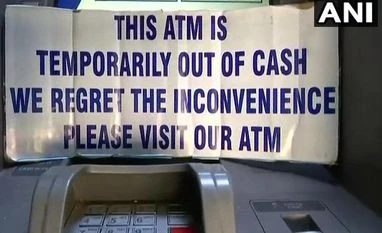
A cash crunch at ATMs has hit a dozen states, including Uttar Pradesh, Madhya Pradesh, poll-bound Karnataka, Telangana, Andhra Pradesh, Bihar, Gujarat, Maharashtra, Rajasthan, and Punjab. While the Chhattisgarh Chief Minister said his state, too, was facing a cash crunch, with the crisis expected to pass shortly, bank authorities in Jammu & Kashmir and the government in Maharashtra said their respective states were not facing an ATM cash crunch. With automated teller machines (ATMs) drying up, the central government and the Reserve Bank of India (RBI) stepped in to address the currency shortage.
Finance Minister Arun Jaitley attributed the cash shortage to an unusual spurt in demand during the past three months and described it as "temporary", adding that the ATM cash crunch was being "tackled quickly" and that there was "more than adequate" currency in circulation. To fix the ATM cash crunch, the government said that the printing of Rs 500 denomination notes, about 5 billion of which are printed per day, would be increased by five times. Notes worth Rs 700-750 billion (Rs 70,000-75,000 crore) would be printed in a month.
Here are the top 10 developments on ATM cash crunch across several Indian states:
1. SBI Research pegs cash shortfall at Rs 700 billion: SBI Research on Wednesday pegged the cash shortfall in the system at a whopping Rs 700 billion (Rs 70,000 crore), which is a third of the monthly withdrawals at ATMs, reported PTI.
The higher level of economic activity in the fourth quarter may have also resulted in more withdrawls at ATMs, the report said in the note.
The report also dismisses notions of the rising demand being due to proposals in the Financial Resolution and Deposit Insurance Bill, saying those were mooted over five months ago.
2. Printing of Rs 200 notes to be blamed for cash crunch? The report explains that a part of the reason why the shortage is being felt could be the introduction and faster- acceleration in printing Rs 200 notes.
"This may have altered the demand for smaller denomination notes in a larger way to possibly substitute for the currency of larger denominations," it said, according to news agency PTI.
"As ATMs have to be replenished more frequently, it can lead to the conjecture that cash is not available," the report added.
The RBI on Tuesday attributed the shortage to "logistical issues" in both replenishing ATMs with cash and also recalibrating those to accommodate the Rs 200 notes.
3. Govt mint halts printing on ink shortage, say unions: Non-availability of ink has resulted in a halt in printing of Rs 200 and Rs 500 denomination banknotes at the Currency Note Press here, an employees' union leader claimed on Wednesday.
"The ink used to print the notes is imported, which is not available now, leading to a halt in printing of these Rs 200 and Rs 500 banknotes," Jagdish Godse, the president of press workers federation said, according to PTI.

 "ATM cash crunch: SBI Research says Rs 200 notes' printing a reason; updates")












 Connect with us on WhatsApp