
Best places in India to see Sunday's 'Ring of Fire' solar eclipse
It will be the first solar eclipse of this year takes place on the summer solstice, which is the longest day in the Northern Hemisphere
 "Best places in India to see Sunday's 'Ring of Fire' solar eclipse")
premium
WebinarsNew
Deep DiveNew
Explore Business Standard
It will be the first solar eclipse of this year takes place on the summer solstice, which is the longest day in the Northern Hemisphere
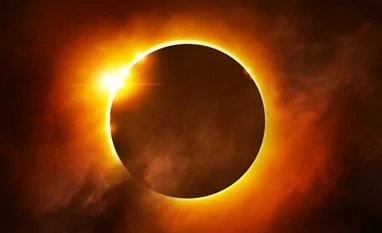
A rare celestial event, an annular solar eclipse, which is popularly known as the "ring of fire" eclipse, will be visible this Sunday in India.
It will be the first solar eclipse of this year and will take place on the summer solstice, which is the longest day in the Northern Hemisphere.
While people living along the path of the annular eclipse passing through Anupgarh, Suratgarh, Sirsa, Jakhal, Kurukshetra, Yamunanagar, Dehradun, Tapowan and Joshimath will be able to see the annular phase, people in rest of India can witness a partial eclipse, said the Ministry of Science and Technology.
When the Moon comes between the Sun and Earth, the shadow falls on the surface of the Earth. The Sun is entirely covered by the Moon for a brief period. Those places that are engulfed by the dark, dense umbral shadow of the Moon experience the total solar eclipse. In the regions that plunge into the soft diffused penumbral shadow of the Moon experience a partial eclipse.
"Annular solar eclipse is a particular case of the total solar eclipse. Like the total solar eclipse, the Moon is aligned with the Sun. However, on that day, the apparent size of the Moon happens to be a wee smaller than the Sun. Hence the Moon covers the central part of the Sun, and the rim of the Sun appear like a 'ring of fire' in the sky for a very brief moment" explains Samir Dhurde of The Inter-University Centre for Astronomy and Astrophysics, Pune.
During the solar eclipse, the apparent size of the Moon is smaller than that of the Sun by 1 per cent, the expert said.
Allying rumours that the eclipse will mark the end of coronavirus, Aniket Sule, Chairperson, Public Outreach and Education Committee of the Astronomical Society of India, said: "Solar eclipse is caused when the Moon comes in front of the Sun for a short time. As seen from Earth eclipses occur somewhere in the Earth 2 to 5 times a year. Eclipses do not impact microorganisms on Earth. Likewise there no danger in eating of stepping out during an eclipse. No mysterious rays come out of the Sun during an eclipse.
Already subscribed? Log in
Subscribe to read the full story →

3 Months
₹300/Month
1 Year
₹225/Month
2 Years
₹162/Month
Renews automatically, cancel anytime

Premium stories handpicked daily by our editors


News, Games, Cooking, Audio, Wirecutter & The Athletic
Digital replica of our daily newspaper — with options to read, save, and share


Insights on markets, finance, politics, tech, and more delivered to your inbox
In-depth market analysis & insights with access to The Smart Investor


Repository of articles and publications dating back to 1997
Uninterrupted reading experience with no advertisements


Access Business Standard across devices — mobile, tablet, or PC, via web or app
First Published: Jun 20 2020 | 2:51 PM IST


 Connect with us on WhatsApp