Marco Pierre White, 58, doesn’t always play nice. The tall Englishman with dark unruly hair and light penetrating eyes can intimidate before he utters a word. In the kitchen or not, I quickly understand, taking on White can mean staring at the sharp edge of a cleaver.
I am meeting the legendary chef, who is known as much for his modern British and French cooking as for his searing temper, at the J W Marriott Hotel in Aerocity on his first visit to Delhi. The wine is being poured rather generously for a Wednesday afternoon as I approach his table for a tête-à-tête. White is curating the dinner tonight but, glass of red wine in one hand and Marlboro Red in the other, he seems perfectly relaxed.
White moved out of hot kitchens and into the cool world of celebrity restaurateurs some 20 years ago. This is what he does these days — travel the world, whipping up specials for private audiences for a hefty price and sharing anecdotes from his storied past. He will soon be charging his moneyed customers £7,000 each for a luxurious, three-day culinary experience in the Scottish Highlands. Right now, White is in Delhi for Season 5 of “World on a Plate”, a gourmet food festival on February 15 and 16, which will also have restaurants in the city compete for the year’s best restaurant title.
Unlike in his heyday when he ruled his kitchens with a whip and chased perfection with a zeal that bordered on lunacy, his brand of restaurants across the UK today — such as the chain of Marco Pierre White Steakhouse, Bar & Grill — run just on his name. White lends them his popularity and his experience but not his service. More reason why Michelin food inspectors won’t come knocking.
“The Michelin guys emailed me recently saying that they want to include me in the guide. I emailed back saying, ‘Thank you, but I’d rather not’,” says White. He lights another cigarette and then we light a few more. He ruminates on the state of restaurants today, about modern-day chefs and why Michelin stars are a spent currency. “Earlier they used to visit a restaurant up to six times unannounced before filing their report,” White recalls.
White shot to fame in 1994 when he became the first Briton to win three Michelin stars. He was 33, the youngest in Michelin history at the time and quickly became a working-class hero. The young lad from Moor Allerton, Yorkshire, started work at 13 doing rounds for the neighbourhood milkman for £5 a week.
White’s mother died when he was just six. He was the youngest of four brothers. Dyslexic, he performed terribly at school and was humiliated by most teachers, he reveals in his autobiography, White Slave, co-written by journalist James Steen. He dropped out of school and knocked on hotel doors in Harrogate for his first job as a kitchen apprentice at 16. He worked double shifts as a commis under famous chefs, such as brothers Albert and Michel Roux (Le Gavroche) and Pierre Koffmann (La Tante Claire) to survive in London at 19.
After three years at Le Gavroche, he moved to Le Manoir aux Quat'Saisons, French chef Raymond Blanc’s country house hotel in Great Milton, Oxfordshire in England. Short stints at Lampwick’s and Leoni’s Quo Vadis, an Italian restauraunt in Soho, followed, before he met restaurateur Nigel Platts-Martin. At 24, White became the head chef and joint owner of Harveys, a French cuisine restaurant, in partnership with Platts-Martin.
His first two Michelin stars came at Harveys in Wandsworth Common, his first restaurant in London. “We got one and then we were going broke by the end of the year, then we got another and we could raise the prices a bit, and we survived,” says White. The prices were raised, and so the standards had to be, too. White’s first cookery book, White Heat 25, published in 1990, was also hailed as an instant classic.
White’s grandfather was a chef, so was his father and so are two of his three brothers. His father was a strict disciplinarian. Verbal and physical humiliation was not uncommon. “He was a psychopath,” says White matter-of-factly, “but he taught me how to work hard, very hard, to be punctual, to never call in sick.” And that’s what White expected from his staff.
The third star arrived after he moved to the city’s Hyde Park Hotel and opened The Restaurant Marco Pierre White. This is also where he cemented his reputation: as the bad boy of the UK food industry, a wrecking ball who spared no one. And his irascibility by then had taken a more violent form.
White once sent blocks of ripe cheese flying on to the kitchen wall while abusing the maître d'hôtel for their asymmetry. He let them remain on the wall for a day for everyone to see. He once cut holes in one of his chef's uniforms with a paring knife because the latter complained about the heat in the kitchen.
"Yes, I would get angry sometimes and yell. You get called an arse**** a lot in three-star kitchens. That's how it was. But I would publicly apologise later if I had overreacted," says White.
Gordon Ramsay, 53, another feared British chef who has been awarded a total of 16 Michelin stars at various restaurants, worked for White at Harveys for about a year. About a controversy that White made Ramsay cry, White publicly said that Ramsay "made himself cry". White had also once said that “men can absorb pressure better” and that they were “not as emotional” during an interview to The Irish Times. (I slyly ask him why there are more men than women in commercial kitchens, to which he cryptically replies that “women are better cooks”.)
White finally hung up his apron in 1999 at the age of 38. "I would leave home when my children were sleeping and I would come back when they were sleeping," says White. He says he chose freedom rather than "living a lie" by not being behind the stove at his own restaurant.
Since then he has been on TV in the British version of Hell's Kitchen, belittling celebrity contestants, and has had guest appearances in MasterChef Australia, showering comments that moved contestants to tears. But like his other angry colleague, Ramsay, he did not make his millions there. "Reality TV is cynical by nature. They are trying to find negativity and feed you controversies in the name of food," says White. "It's pretentious."
And so is wine and food pairing, and 16-course meals. "Why should someone tell you what to drink and how much you should eat? They are showing off and not sharing," says White. By serving controlled portions on little plates, he says modern chefs have turned a canapé party into a dinner party. But he likes how generously Indians serve their food.
He is telling me about his hotel in Bath and how he is more interested in hospitality these days when the commotion from a wedding procession outside the hotel takes over the conversation. "I think I should get into the wedding business here," he yells from across the table. His restaurants were usually overwhelmed with guests and he has catered many brunches in the UK. But I wonder how this extremely particular chef, who is sticking to a conventional Western four-course meal tonight, will be able to dish out a 40-course menu for up to 1,000 people. And what his staff will have to endure. White may be an extraordinary chef but he’s a devil when he gets into the details.

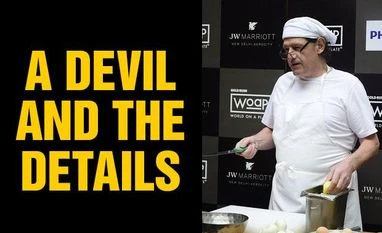 "British chef Marco Pierre White can cook up a storm in more ways than one")












 Connect with us on WhatsApp