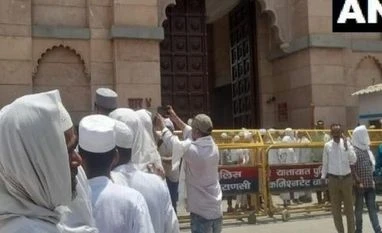
Security was tightened and prohibitory orders under Section 144 were imposed in Varanasi as a district court will pronounce the verdict on the maintainability of the suit in the Gyanvapi mosque-Shringar Gauri case on Monday. District Judge A K Vishvesh had last month reserved the order till September 12 in the communally sensitive matter.
Five women had filed the petition seeking permission for daily worship of Hindu deities whose idols are said to be located on an outer wall of the Gyanvapi mosque, which is located close to Kashi Vishwanath temple. Following this, a Varanasi court ordered the survey of the mosque complex. After the survey, it was claimed that a 'shivling' was found in the mosque compound.
Meanwhile, the Anjuman Intezamia Masjid Committee has said the Gyanvapi mosque is a Waqf property and has questioned the maintainability of the plea. Madan Mohan Yadav, a lawyer of the Hindu side, had said that the mosque was constructed after demolishing the temple.
What does the petitioner argue?
According to the petitioner, a self-styled Jyotirling of Lord Vishwanath in Kashi (Varanasi) is in the mosque complex. The petitioner also claimed that in 1669, Mughal Emperor Aurangzeb had destroyed a portion of the Kashi Vishwanath temple and had built the Gyanvapi Mosque. The petitioner wants the court to declare that Muslims have no right to occupy the Gyanvapi mosque and their entry to be banned.
What has the defence said?
According to the defence, there was no temple in the Gyanvapi complex and the mosque is standing on the site from the start.
What has the Supreme Court said?
The Supreme Court on July 21 that it will await the Varanasi district judge's decision on the Gyanvapi mosque committee's application. The SC bench then posted the matter for further hearing in the first week of October after the outcome of the proceedings before the district judge.
On May 20, the apex court transferred the civil suit filed by Hindu devotees from civil judge (senior division) to the district judge of Varanasi in the Gyanvapi case. Citing the "complexities" and "sensitivity" of the issue, the SC said it is better if a senior judicial officer having an experience of over 25-30 years handles this case. The top court had made the observation that the process to ascertain the religious character of a place of worship is not barred under the Places of Worship Act of 1991.
This came after the commission appointed by a district court to conduct a video surgey of the Kashi Vishwanath temple-Gyanvapi Mosque complex submitted its report on May 19.
The top court in an earlier order on May 17 had directed the protection of the area where the 'shivling' was allegedly found in the mosque. The SC also allowed Muslims to offer in the mosque premises until the final verdict in the maintainability of the suit.
(With PTI inputs)
Read this article for free
Register to continue reading premium journalism and analysis from Business Standard.

 "Court's verdict in Gyanvapi Mosque case today: All you need to know")











