Home / Health / Covid-19 antibody seroprevalence down at 25% in Delhi: Survey report in HC
Covid-19 antibody seroprevalence down at 25% in Delhi: Survey report in HC
Seroprevalence of antibodies to Covid-19 reduced to 25 per cent in September from nearly 29 per cent last month among people in the national capital, the Delhi High Court was informed
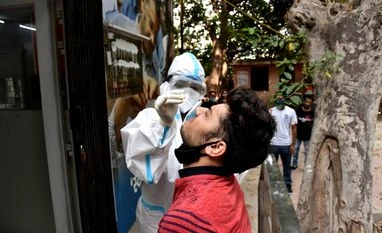
A health worker collects a nasal sample from a man at a Mohalla Clinic to conduct tests for the coronavirus disease (COVID-19), amid the spread of the disease, at Greater Kailash in New Delhi on Wednesday
Seroprevalence of antibodies to COVID-19 reduced to 25 per cent in September from nearly 29 per cent last month among people in the national capital, the Delhi High Court was informed on Wednesday.
These are the findings of the third round of sero surveillance carried out by the AAP government in the national capital between September 1 to September 7.
The report was placed before a bench of Justices Hima Kohli and Subramonium Prasad during the hearing on a PIL seeking increase in the COVID-19 testing numbers in the national capital and getting speedy results.
The report, filed through Delhi government additional standing counsel Satyakam, indicated that there was a reduction in the "antibody seroprevalence" from 28.7 per cent in August to 25.1 per cent in September.
It also showed that there was a significant decrease in seroprevalence in north east, north and central districts of Delhi, while there was a slight increase in south, east, west and north west districts.
The seroprevalence was more in females during all the rounds of the survey and it was the least in the 18-49 years age group, as compared to age groups of less than 18 years and more than 50 years, it said.
"Seroprevalence was increased in participants belonging to the low socio-economic status and those living in unplanned colonies," the report said and added that this was probably due to difficulties in maintaining social distancing and hygiene measures amongst people of these categories.
The Delhi government surveyed 17,409 people across the national capital.
The report stated that asymptomatic infections were manifested in most cases during all the sero survey rounds and diabetes mellitus was observed to be a risk factor for subclinical infection.
The sero survey also found that nearly one-third of the participants with a past history of COVID-19 infection, "did not have detectable IgG antibodies".
"However, there is evidence that antibodies to COVID-19 may deplete over time," it added.
The surveyors have recommended that there is a need to space the sero survey rounds and future surveillance should focus more on "ensuring representativeness of the sample in terms of settlement type and socio-economic status".
The Delhi government told the bench that it will inform the court on the next date of hearing on October 7 as to when it will conduct the next round of sero survey.
(Only the headline and picture of this report may have been reworked by the Business Standard staff; the rest of the content is auto-generated from a syndicated feed.)

 "Covid-19 antibody seroprevalence down at 25% in Delhi: Survey report in HC")


