Covid winter sparks scramble for pvt hospital beds in Delhi, Mumbai stable

Delhi reels under a strong second wave of infections with daily tally of over 8,000 cases, Mumbai seems to be breathing easy with almost one-eighth that number
coronavirus
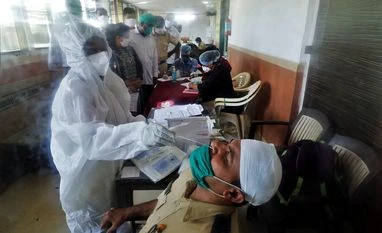
A healthcare worker wearing personal protective equipment(PPE) collects a nasal sample from a policeman, during a check-up campaign for the coronavirus disease (COVID-19) set up inside a police station, in Mumbai.
Sohini DasRuchika Chitravanshi Mumbai/New Delhi
4 min read Last Updated : Nov 14 2020 | 1:16 AM IST
The Covid winter may pan out differently for two of the countries most important cities - Delhi and Mumbai. 

While Delhi reels under a strong second wave of infections with a daily tally of over 8,000 cases, Mumbai seems to be breathing easy with almost one-eighth that number. Making matters worse, there is a scramble for private hospital beds in the national capital even as the government data shows that beds are lying empty in dedicated Covid Care Centres. 

Cases have been increasing post Dussehra, says Dr Rajesh Chawla, senior pulmunologist, Indraprastha Apollo Hospitals. He adds that the beds at Apollo are running at full capacity and that the problems are only going to increase further. 

Is there scope to increase beds at these leading private healthcare facilities? Not really. Dr Chawla claims that of the 600 beds they have, around 300 beds are for Covid cases. "There is no space to increase more beds. Private hospitals also have to cater to non-Covid patients," he quips. 

In fact, Delhi government has knocked doors of the apex Court in the country challenging a High Court order that stayed the Delhi government's September decision to reserve 80 percent of the ICU beds in 33 private hospitals for Covid patients. On Thursday, however, the Delhi High Court said that 80 percent ICU beds at 33 private hospitals can be reserved for Covid patients. 

ICU beds in government facilities are fully occupied too. Delhi's largest Covid hospital, Lok Nayak Jai Prakash Narayan Hospital (LNJP), has almost all its ICU beds occupied. The 2010 bed facility with oxygen facility in each bed is has around 350 patients in the ICU now. Ritu Saxena, chief medical officer, LNJP Hospital says,"The peak of delhi is going on right now and we are fully prepared. All our ICU beds are almost fully occupied. We are getting only severely sick patients...people with co-morbidities are coming to us." 

She admits that patients are having trouble getting beds in private hospitals and many such people are now rushing to LNJP. Saxena adds that LNJP has sufficient beds.The hospital does not have any immediate plans of adding more beds since it also requires increasing manpower. "To increase the number of beds we need more manpower also. We will run the existing beds smoothly," she adds. 

Mumbai is faring way better at the moment, beds, however are not really vacant at private hospitals. Fortis Healthcare, for example, is running near full capacity in Delhi and has limited beds available in Mumbai. Dr Bishnu Panigrahi, group head, medical strategy and operations, Fortis Healthcare explains, "Fortis had committed 1,278 beds for Covid patients as on October 1 in across all its hospitals. By Tuesday night, 1,150 beds were occupied across the country. The hospital is running near full capacity in Delhi and has limited beds available in Mumbai." 

Doctors, however, point out that the spike in cases has got less to do with the virus and more with people's behaviour - rush for Diwali shopping and nonchalant attitude towards wearing masks or maintaining social distancing. The worry is with Delhi winters and rise in pollution levels the mortality rates would increase. Randeep Guleria, director of the All India Institute of Medical Sciences, Delhi said this week that higher levels of air pollution will not only aggravate the disease (Covid19), but can also lead to increase in mortality. Lungs tissues get inflammation due to air pollution, and combined with Covid the situation can worsen, worry experts. 

In Mumbai, on the other hand, the wait for ICU beds has reduced. CEO of PD Hinduja Hospital in Mumbai Gautam Khanna said that a month ago there was a two days waiting period for an ICU bed in the city. "Now we have beds available on wards and in the ICU. Since the last 10-days the number of patients coming to the hospital is going down and we have spare capacity," he adds. 

In Mumbai hospitals have worked closely with the BMC war-rooms to allocate patients swiftly. This has ensured a better patient flow management and with just over a 1000-daily cases now, the rush for hospital admissions is only around 125-150 patients daily. 

Hospitals, however, are not getting complacent and reducing bed capacity for Covid patients. Hinduja, for example, is keeping 30 percent vacancy for Covid19 victims and has a dedicated Covid19 building. 


One subscription. Two world-class reads.

Already subscribed? Log in

Subscribe to read the full story →
*Subscribe to Business Standard digital and get complimentary access to The New York Times

Smart Quarterly

₹900

3 Months

₹300/Month

SAVE 25%

Smart Essential

₹2,700

1 Year

₹225/Month

SAVE 46%
*Complimentary New York Times access for the 2nd year will be given after 12 months

Super Saver

₹3,900

2 Years

₹162/Month

Subscribe

Renews automatically, cancel anytime

Here’s what’s included in our digital subscription plans

Exclusive premium stories online

  • Over 30 premium stories daily, handpicked by our editors

Complimentary Access to The New York Times

  • News, Games, Cooking, Audio, Wirecutter & The Athletic

Business Standard Epaper

  • Digital replica of our daily newspaper — with options to read, save, and share

Curated Newsletters

  • Insights on markets, finance, politics, tech, and more delivered to your inbox

Market Analysis & Investment Insights

  • In-depth market analysis & insights with access to The Smart Investor

Archives

  • Repository of articles and publications dating back to 1997

Ad-free Reading

  • Uninterrupted reading experience with no advertisements

Seamless Access Across All Devices

  • Access Business Standard across devices — mobile, tablet, or PC, via web or app

Topics :CoronavirusDelhiMumbai

Next Story


