The historic site of the Nizamuddin dargah resembles a fortress these days. Days after the Markaz mosque, which became Delhi’s epicentre of the coronavirus disease (Covid-19), was evacuated and sanitised, an eerie silence hangs over the area, with armed men wearing protective masks dotting the perimeter and barricades all over.
All entry and exit points of the dargah leading up to the basti have been sealed. The tent pitched by a team of doctors outside the Markaz mosque — to test people at the site where a religious meeting was held last month and multiple persons who attended the meeting tested positive for Covid-19 — still stands, abandoned.
Just a couple of days ago a team of doctors geared up in personal protective equipment and a battery of Central Reserve Police Force (CRPF) jawans were escorted into the back alleys of the dargah.
“After what happened in Madhya Pradesh with the doctors, we don’t want to take any chance,” one of the policemen posted at the Mathura road entrance said.
Last week, healthcare workers and civic officials were attacked by a mob in Indore when they went to survey residents for Covid-19 symptoms.
Nearly 1,500 houses in the area have been surveyed in the past few days, Mukesh Walia, Nizamuddin station house officer said. The questions posed in the survey are simple: How many people live in the house? Does anyone have symptoms of cold and fever?
“We are maintaining law and order and implementing the lockdown strictly...There are no specific instructions to us for after April 14 yet,” Walia said.
So far, there has been no positive case. However, CRPF and police personnel do not want to leave anything to chance. Inside the narrow alleys of the basti, two CRPF companies — around 150 armed guards — have been deployed to keep a check on any unnecessary movement.
“Inka koi bharosa nahi hai,” one of the officers on duty said, suggesting that the people might not be disciplined enough to follow lockdown in the cramped area.
The law enforcers arrive every day around 8 am and stay till late evening. They come with complete gear, including tear gas munitions. When asked about the tear gas, a CRPF jawan simply points towards the basti and shrugs while he says, “Who knows what can happen?”
However, police know arms and ammunition are not enough in this war against Covid-19. Many on duty at the local police station even shaved their heads after they heard that hair can also be a carrier for the virus.
Several of those guarding Delhi’s hotspot are staying away from their families. “We stay back at the police station...We don’t want to put our families at risk. For us this is our duty,” Ravinder Kumar, a junior police officer said.
The neighbouring housing society of Nizamuddin West is also complaining of how online delivery services are being cautious and most have refused to cater to the area. The local vegetable vendor manages to enter with a curfew pass. “I get vegetables from the Okhla mandi, which is so crowded that it is impossible to maintain any distance with people... But what else to do,” said Surender Sharma, vegetable vendor.
The divide between rich and poor in the south Delhi neighbourhood is apparent.
The dargah has become home to more than a hundred people who lived outside its campus, as they were booted out of their shanties into a park adjoining the religious site.
“We have enough supplies for the next two days. My husband is a rickshaw puller and now there is no work. I don’t know how I will manage,” said Noor Jehan, a mother of six children, who is living at the dargah.
She said sometimes the CRPF personnel share their leftover food with them, which gets them by for a meal or two.

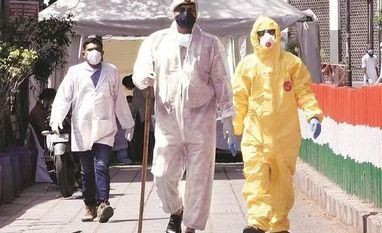 "Days after Markaz event, Delhi's Nizamuddin dargah turns into a fortress")












