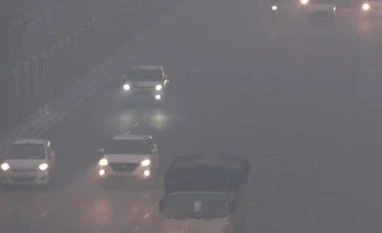
Delhi wakes up to thick smog, air quality index dips to 'severe' again
While the forecasters on Wednesday predicted the air quality was likely to improve on the back of stronger winds, the overall Air Quality Index (AQI) of Delhi stood at 426 at 9.10 am
Press Trust of India Delhi's air quality continued to be in the 'severe' category on Thursday, according to Central Pollution Control Board data
While the forecasters on Wednesday predicted the air quality was likely to improve on the back of stronger winds, the overall Air Quality Index (AQI) of Delhi stood at 426 at 9.10 am.
An AQI of above 400 is considered severe and can affect healthy people and seriously impact those with existing illnesses.
Anand Vihar and Jahangirpuri were the most polluted places in the capital with AQI at 460.
The areas that recorded Severe AQI are Alipur (439), Ashok Vihar (444), Bawana (456), Burari (443), Mathura Road (412), DTU (436), Dwarka (408), ITO (435), Mundka (438), Narela (447), Nehru Nagar (433), Patparganj (441), Rohini (453), Sonia Vihar (444), Vivek Vihar (444) and Wazirpur (444).
The AQI continued to remain in the very poor' category in Ghaziabad (391), Noida (388), Greater Noida (390), Gurugram (391) and Faridabad (347), the CPCB data stated.
An AQI between zero and 50 is considered "good", 51 and 100 "satisfactory", 101 and 200 "moderate", 201 and 300 "poor", 301 and 400 "very poor", and 401 and 500 "severe".
This comes a day after Punjab reported the highest number of farm fires. According to the Indian Agricultural Research Institute (IARI), Punjab reported 3,634 farm fires on Wednesday, the highest this year so far.
SAFAR, a forecasting agency under the Ministry of Earth Sciences, had earlier said stubble burning accounted for 32 per cent of the PM2.5 pollution in the capital on Wednesday.
Transport-level winds blow in the lowest two layers of the atmosphere -- the troposphere and stratosphere -- and carry smoke from farm fires to the national capital region.
PM2.5 are lung-damaging fine particles that are 2.5 micrometers or less in diameter and can travel deep into the respiratory tract, reaching the lungs and entering the bloodstream.
(Only the headline and picture of this report may have been reworked by the Business Standard staff; the rest of the content is auto-generated from a syndicated feed.)

 "Delhi wakes up to thick smog, air quality index dips to 'severe' again")


