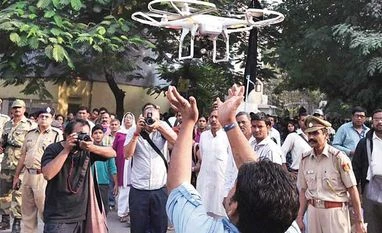
A foreigner flying an unmanned drone in the high-security Vijay Chowk area, near the Rashtrapati Bhavan and Parliament, in New Delhi had sent the police into a tizzy in October last year.
In the same month, a Central Industrial Security Force officer was suspended after an unidentified flying object was spotted hovering near the Indira Gandhi International Airport in New Delhi.
In possibly a bid to regulate unmanned flying devices that could become a security and safety hazard, the Directorate General of Civil Aviation (DGCA) has issued draft guidelines.
Drone users would have to obtain a permit and secure a unique identification number (UIN) for each drone, if the rules are approved.
India is not the first country to do so. The US tightened its rules on drones after a man was caught in March last year trying to fly a drone over the walls of the White House.
Now, drones or unmanned aircraft are being used for several purposes such as mapping, survey and commercial photography, while e-commerce giant Amazon is looking to use them for deliveries to its consumers in the US.
However, drones are also viewed as a security risk and even the International Air Transport Association has referred to drones as threat in airspace and called for a greater stakeholder engagement to ensure safety.
The draft regulations are a first step to legalise the use of drones in India but owners or operators would need to follow some of the stringent criteria that is required to own and operate an airline.
The DGCA has proposed the UIN will be granted to an Indian citizen or a company whose chairperson and two-thirds of its directors are Indian citizens.
Also "substantial ownership and effective control" of the company needs to be vested with Indians. The user will also require a security clearance from the Bureau of Civil Aviation Security.
The user would require a DGCA permit for all drone operations at or above 200 feet over ground in an uncontrolled airspace.
The draft regulations state that "operations of civil unmanned aircraft in controlled airspace are restricted".
It also states that drones can enter a controlled airspace only with prior approval of air traffic control and will require formulation of standing operating procedures.
A controlled airspace is an area where prior clearance of the air traffic control tower is required for flight movement. The restrictions ease as one travels further away from an airport. For instance controlled airspace of Mumbai airport covers a radius of 40 nautical miles (from airport) and a height of 14,000 feet and below. Outside 40 nautical miles area, a height up to 7,000 feet is not treated as controlled air space of Mumbai airport.
According to the rules, drones shall not be allowed to be flown over the entire air space of Delhi and also other sensitive locations such as nuclear plants or military facilities and areas within 50 km of international borders.
Also the drones will not be used to discharge or drop substances unless it is specifically mentioned in the permit and will not carry any explosives or dangerous goods. The draft regulations also cover aspects related to maintenance of drones and training of remote pilots operating them. The remote pilots, for instance, need to be 18 years of age, and have ground training equivalent to that of private pilot's licence holder apart from proficiency in handling of drones.
"The DGCA draft regulation is a step in the right direction. Given the odds it is better to have a regulation around the use of these high-potential devices than have nothing at all. The bigger concern for the industry is enforceability of these regulations and ensuring that the DGCA has both the technology as well as the staff to ensure that the regulations are met. Now, the DGCA has one official overseeing every two aircraft while at the US Federal Aviation Administration there are on an average three officials overseeing every aircraft on its register," said aviation consultant Mark Martin.
REGULATIONS IN OTHER NATIONS Other countries, such as the US and Singapore, have already come up with regulations for drones
United States All small unmanned aircraft weighing over 0.55 pounds need to be registered before outdoor flight
Regulations: Citizens of 13 years of age or above can register unmanned aircraft through a web-based system. Non-citizens get an ownership certificate
Penalty: If regulations are violated, civil penalties of up to $27,500 and criminal penalties of up to $250,000 and three years' imprisonment could be imposed
Singapore Two types of permits are granted, for operators and for activities
Regulations: Permits required from various agencies for certain aspects of unmanned aircraft operation, such as Singapore Police Force (SPF) for aerial photography or flight of over security-sensitive locations, or Infocomm Development Authority of Singapore for the use of radio frequencies
Sources: US Federal Aviation Administration and Civil Aviation Authority of Singapore websites

 "Drones face net of rules")


 Connect with us on WhatsApp