S Somanath, project director, said: “India has now a new launch vehicle. The payload capability of the Indian rocket has been enhanced significantly.”
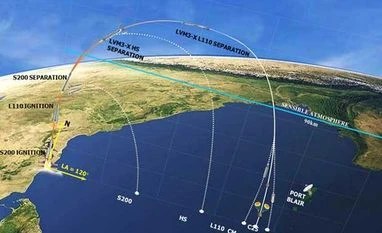
The Rs 155-crore mission has two purposes. The main purpose is to test the rocket’s atmospheric flight stability with four-tonne luggage. The second is to study re-entry characteristics of the crew module, its aero braking and validation of its end-to-end parachute system. The capsule was the size of a small bedroom and could accommodate two to three.
According to Isro, the crew module separated from the rocket at an altitude of 126 kilometres (km) and re-entered the earth's atmosphere at 80 km. At an altitude of 15 km, the module’s apex cover separated and parachutes were deployed. These parachutes were designed and made by the Defence Research Development Organisation's laboratory at Agra. The crew module weighed 3.73 tonnes. It separated from the rocket about five minutes after the lift-off from the launch pad.
After the parachutes opened on re-entry, the module landed in the Andaman Sea, about 1,600 km from Sriharikota. The vehicle has now moved a step closer to its first development flight with a functional C25 cryogenic upper stage engine.
A naval ship tracking the signals from the module would pick up the module and it will be delivered at Ennore Port, near this city. From there it will be brought to Sriharikota and then taken to the Vikram Sarabhai Space Centre at Thiruvanthapuram in Kerala.
The Mark III was the second GSLV rocket mission during the past four years. Two such rockets failed in 2010 and this was designed to be a three-stage one, with a lift-off weight of 630 tonnes.
Isro's being able to perfect the cryogenic engine technology would enable foreign exchange to be saved by launching communication satellites itself, beside taking larger orders from others.

 "GSLV Mark-III lifts off successfully from Sriharikota")


 Connect with us on WhatsApp