7 min read Last Updated : May 18 2019 | 12:38 AM IST
Don't want to miss the best from Business Standard?
Ajita Madhavji utters the word “Hamilton” with an emphasis that suggests it means more. In her estimation the name of the photography studio, built by Sir Victor Sassoon in 1928 and taken over by her father Ranjit Madhavji in 1957, stands for an artistic sophistication that ostensibly separated it from other studios of its time. “Out of thousands of photos I can pick out ‘a Hamilton’ in an instant,” she says with no small measure of pride. “The pictures are technically right with very dramatic lighting.”
The studio premises in Ballard Estate in South Mumbai are itself an archive for another era. A curtain of bells hangs at the entrance to alert the staff inside of visitors. The parlour where lensman and client would discuss particulars over tea, a dressing room, and the studio room with an imposing 1928 Kodak plate camera are as if frozen in time. Heavy wooden tables covered in lace, chairs upholstered in satin and a rotary-dial telephone are still in use. Photographic supplies such as box-camera bulbs and tints used for hand-painting frames are obsolete in most places but here.
Hamilton Studios in Mumbai’s Ballard Estate
Sassoon, a Baghdadi Jew and descendent of David Sassoon who also built many historical institutions in Mumbai, launched the business to further his passion for photography. Its title drew from the 18th-century European model, Lady Hamilton. Sassoon later sold it to Ranjit Madhavji, also a photography hobbyist, and in their brief interaction, he requested that the establishment be maintained as is. Ajita Madhavji inherited the studio in the 1980s. After years of keeping the promise and staying strictly analog, it has embraced digital technologies but only for the purpose of restoration. Glass plates and celluloid prints, mainly bearing visages of lords, ladies, and maharajas are being cleaned, scanned and catalogued online. And there is excitement over what cultural knowledge these could resurrect about Bombay as it was in the first half of the 20th century.
The studio parlour with copies of its prized photos
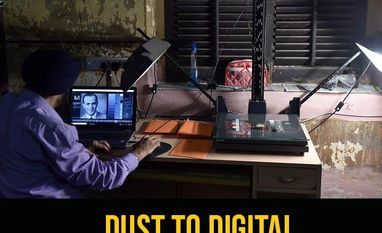
Hamilton has shot some 600,000 images over the years, which have survived unforgiving humidity, a flood, termites and some three decades of litigation — the last as a result of the National Textile Corporation, in whose building the studio is housed, wanting its tenants out. Amidst this, it had seemed daunting for Madhavji to embark on an archiving mission but she found reliable partners in Jason Scott Tilley and Ben Kyneswood, the UK-based duo behind “Photo Archive Miners” which brings out narratives from rare photo archives around the world. Together, they made a winning pitch to the British Library’s Endangered Archive Programme, because of which some 200,000 of the negatives, rough prints and memorabilia, largely dating between 1928 and 1947, are being digitised.
A carefully restored family photograph
By this arrangement, commercial ownership remains with Madhavji, while also allowing her to make the public aware of Hamilton Studios. The photos will be made available for reference online, and the team is planning an exhibition in London. After the project was announced, emails and snail mail have arrived from foreign shores enquiring about old family photographs, and showing interest in funding the next stages of archiving.
Since work began in February, 6,000 such photographs have been scanned. Tilley and Kyneswood visited Madhavji and the studio in Mumbai last September. Six months were lost as the precision instruments they carried were held and investigated by customs. Meanwhile, three work stations were created in one of the rooms in the back of the white and mint-green studio, and the trio trained interns in cleaning negatives and using software to make digital positives. While Sassoon’s staff had maintained catalogues from the beginning, some of the entries are too brief. Several of the headshots, for instance, bear only the name of the companies for which the sitters used to work. As several of the companies are now defunct, it is difficult to put names to faces.
Other entries encouragingly come with handwritten correspondence in which the studio offered price lists or clients placed orders. In what could be a lesson in respecting privacy, Madhavji insisted that age-old requests made in some of the letters be honoured even today. Rough prints that clients had asked not to be made public will not be shared online. Some of the glass plates, which had not been out of their slips for 90 years, look brand new and the precise instruments have been able to capture the mild grading of the old chlorobromide prints. Madhavji is in search of more interns who can carefully handle the ageing envelopes, make notes and photograph the material. For researchers studying the significance of the photography studio and the studio photographer, this collection could prove significant.
Owner Ajita Madhavji
When it opened, the studio marketed itself as “the most up-to-date in the East”. The target audience was already clear. “New features have been introduced to create portraits of character and distinction in men, beauty and allure in women, charm and unaffectedness in children,” reads one vintage advertisement. Sassoon’s immense social capital meant the stalwarts of cinema, aristocracy and industry posed and preened before Hamilton’s cameras. His simultaneous interests in Shanghai meant that from the start the studio was international.
There was a separate department for amateur photographers and movie makers to buy equipment including 16 mm cinema cameras and projectors. Photographers, including Oscar Seepol who ran a studio in China, had stints in Bombay in the 1930s. Evening gowns from London and tickets to grand balls were among the other things available to be picked up. Some of the best-known early portraits such as of JRD Tata, Madhubala, Nadia Hunterwali, Vijaya Raje Scindia and Mohammad Reza Shah were shot here.
Even before colour processing found its way into the studio, gentle tints of magenta are seen done by hand in the saris and frocks worn by some of the 100-odd subjects in a portrait of the Birla family. Iconic photographs of Madhubala and Vinod Khanna were clicked by Ranjit Madhavji when he assumed ownership. The studio lensmen went outdoors to document a few landmark moments.
Madhavji is now discovering the original prints of some of the images that had been floating credit-less on the internet. For instance, a cropped photograph of the Ballard Pier Mole station, the original of which was shot by Hamilton and fuller details of which have revealed that the train would drop off goods all the way up to the ship. The repertoire also includes journalistic photographs of the “Sunshine Girls” or jazz showgirls from London and the Bombay Amateur Dramatic Company performing in the city, members of the Bombay Jackal Club posing with their prized dogs, and a roadshow in which the telephone was first introduced to the public. Pictures to be used in print advertisements were made for companies such as the erstwhile EDSU Fabrics.
No ordinary family likely walked through the studio doors but the photographs of the rich and famous certainly tell of the high fashions of the day. These examples of the early studio portraits have a lamp-bathed luminosity about them. Weddings, birthdays, graduations were common occasions that people liked to document. The shawls and saris of women were draped in perfectly even folds. The jewellery and makeup were typically slight, while the curtains and furniture used as props were understated in their grandness.
“I would love it if the children of today learnt something from the past which was so graceful,” says Madhavji. When the images are released over a period of two years, she also hopes to get leads from the public on the sitters and locations that would help her to know even better the “Hamiltons” she can identify from a mile.