
High chances of heat wave over west-central, parts of northwest India: IMD
The India Meteorological Department (IMD) on Tuesday forecast a higher probability of occurrence of heat wave over west central and some parts of northwest India.
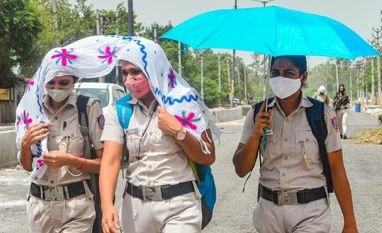 "High chances of heat wave over west-central, parts of northwest India: IMD")
Explore Business Standard
The India Meteorological Department (IMD) on Tuesday forecast a higher probability of occurrence of heat wave over west central and some parts of northwest India.
As part of its Seasonal Outlook for March to May 2022, the India Meteorological Department (IMD) on Tuesday forecast a higher probability of occurrence of heat wave over west central and some parts of northwest India.
The Indo-Gangetic plains, however, will have below normal temperature probabilities and hence, heat wave conditions are not likely higher than the normal over the region.
The minimum temperature during March to May 2022 is expected to be above normal for most parts of northwestern, western, northeastern India, and the east coast, while normal temperature is expected over eastern India, from southern part of West Bengal up to southwest Uttar Pradesh, northern parts of Madhya Pradesh, and interior and southern parts of the peninsular India.
For the rainfall in March 2022, the IMD said it, averaged over the country, most likely to be normal (83-117 per cent of Long Period Average). Below normal rainfall is most likely over most areas of northwest and central India and some parts of northeast India. Normal to above normal rainfall likely over many parts of the south peninsula.
As the changes in the sea surface temperature (SST) conditions over the Pacific and the Indian Oceans are known to influence the Indian climate, the IMD carefully monitors the evolution of sea surface conditions over these ocean basins. Accordingly, currently, La Nina conditions are prevailing over the equatorial Pacific region. The La Nina is likely to weaken during the northern hemisphere spring season and to reach cold ENSO neutral conditions during the second quarter of 2022.
Since 2016, the IMD has been issuing seasonal forecast outlooks for subdivision scale temperatures over the country for both hot and cold weather seasons. These predictions are based on the Monsoon Mission Coupled Forecasting System (MMCFS) Model developed under Ministry of Earth Science's monsoon mission project. Last year 2021, IMD has adopted a new strategy for issuing monthly and seasonal outlooks of rainfall and temperature over the country. The new strategy is based on the newly developed Multi-Model Ensemble (MME) based forecasting system.
--IANS
niv/vd
(Only the headline and picture of this report may have been reworked by the Business Standard staff; the rest of the content is auto-generated from a syndicated feed.)
First Published: Mar 01 2022 | 7:58 PM IST

