IPGME&R and SSKM Hospital -- one of the oldest general hospitals in the country, built by the East India Company in the heart of Kolkata -- is being primed for Covid-19 vaccination on Saturday. Next to the academic building on the campus, a signage, “Covid Vaccination Site”, points to the scene of action – the auditorium building.
Inside, four makeshift sites have been readied, though on the first day, only one will be operational; the government has allowed vaccination of 100 beneficiaries in a session. The 700-seater auditorium has been converted into an observation room, where beneficiaries will wait for 30 minutes after receiving the vaccine shot. The seating areas have been marked for beneficiaries according to the sites. In the first phase, SSKM will be vaccinating more than 8,000 health workers including doctors, nurses, sanitary workers, and medical officers.
With Serum Institute of India (SII) dispatching the Covishield vaccine to 13 cities on Tuesday, the countdown to the vaccination day has begun, and hospitals are getting ready to administer the first shots.
Wednesday was a scene of frenetic activity at most hospitals in Delhi, with many carrying out last-minute changes in the presence of state health officials. But with successful dry runs recently, hospitals seemed confident ahead of the final roll-out.
Apollo has set aside three rooms for vaccination in the coming weeks, with each capable of administering a maximum of 100 shots a day. “The government, however, intends to use only one booth per site, for now. Our process will be completely digital, which will be both safer and quicker,” said Anupam Sibal, group medical director at Apollo Hospitals Group.
Keeping social-distancing requirements in mind, ample space has been provided at the centres with proper cold-chain maintenance and biomedical waste management.
At Bengaluru’s Aster CMI Hospital at Hebbal, the staff is seen giving the finishing touches to arrangements. A 40-member team is working tirelessly to manage the entire exercise. The hospital has a list of 1,500 frontline workers who would be administered the vaccine in a span of three days. In the event of any crisis after the jab, a team of doctors including a pulmonologist, a cardiologist, and a general physician will be on standby.
In the first consignment, Karnataka received 648,000 doses in 54 boxes, which have been stored in a cold-chain facility in Bengaluru. The other cold storage, located in Belagavi, is likely to receive 140,000 doses. In total, over 600,000 frontline workers have registered for vaccination in the first phase, which will take place in over 200 centres.
In Gujarat, 287 vaccination centres, most of which are either municipal schools or health centres, are at different stages of preparations. At the Smt Sushilaben M Shah (SMS) Multi Specialty Hospital, three vaccination centres are ready and 15 hospital beds have been put in place for each of the waiting and observation rooms. At a municipal school, converted into a vaccination centre, however, there is apprehension that the waiting rooms may fall short for the number of beneficiaries.
The Gujarat vaccination drive will be flagged off by Prime Minister Narendra Modi for the 430,000 health workers in the government and private sector; the Delhi drive is likely to be kicked off by Chief Minister Arvind Kejriwal at Lok Nayak Hospital.
On the infrastructure side, last-minute checks and beefing-up are on. About 47,000 vaccination sites across Tamil Nadu have a capacity to store 25 million vaccines. The state has readied as many as 51 walk-in coolers and 2,800 secondary cold-storage points.
Tamil Nadu Health Secretary J Radhakrishnan said it was being checked if cooling was sufficient in the vaccine boxes as they would have to reach remote areas.
During Phase-I, around 500,000 people, including health workers and frontline workers, will receive the vaccine.
Delhi hospitals have been retrofitted with large freezers that can hold up to a few million doses. They will be assisted by the state government.
An official of the health department said on the condition of anonymity, “We have set up cold-storage points — over 500 — wherein each will be connected to around four centres. The logistics will have to be worked out very carefully.”
He added that the government plans to add more centres in the coming weeks, with the number likely to go up to 1,000.
A health department official in West Bengal said minor augmentations might be required, but not for the first phase, in which 600,000 health workers would be inoculated.
The BMC is currently prepared to vaccinate 12,000 persons daily at eight hospitals in the first phase and plans are being worked out to ramp this up to 50,000 persons daily at 75 centres based on the availability of doses. Wednesday morning, it received the first batch of 139,000 Covishield doses.

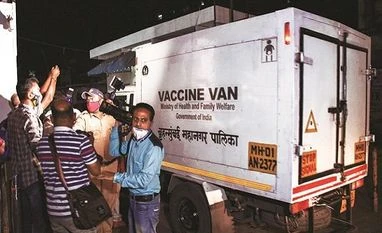 "Hospitals get ready for Covid shots ahead of vaccination drive on Jan 16")









