Residents of Padi, in West Chennai, are used to seeing a small stick-thin boy zipping around the locality's lanes on a red bicycle that looks too big for him. When he isn't playing chess, or table-tennis, or badminton, or doing homework, Rameshbabu Praggnanandhaa cycles.
Last week, when Chennai threw a reception in the eighth standard student's honour, he was apparently unaffected by the pomp and circumstance. The 12-year-old made the statutory speeches and fielded the usual questions in considered fashion. Then he went home, and continued his unending chess match with his 17-year-old akka, Vaishali.
Praggnanadhaa ("People call me Pragg since it's easier") was born on August 10, 2005. There are many references to his exact age because he is the youngest Grandmaster in the world and only two people have achieved that most prestigious title as a pre-teen. The other is Sergey Karjakin, who set the record when he became a GM in 2006 at the age of 12 years, seven months.
"Grandmaster" is a lifetime title. It's awarded to players who maintain outstanding performances over 25 games against opponents of given strength. Between November 2017-March 2018, Pragg had a chance to break Karjakin's record.
He scored his first GM "norm", as it's known, in November 2017, when he came fourth in the World Junior Championship, ahead of several 20-year-old GMs. But he couldn't score the two more norms he needed, before the cut-off date of March 10.
The floodgates opened after that. That first norm came at the World Junior Championships in Tarvisio, a small snowbound town deep in Italy's mountains.
The second norm was scored at the Fischer Memorial Tournament, in Heraklion, Crete, in April. The third norm came on June 23, at another Italian resort, Ortisei, where Pragg tied for first place in the Gredine Open. Tarvisio, Heraklion, Ortisei: three obscure places etched in letters of gold into the annals of Indian chess.
One of the other participants at Ortisei remarked on Pragg's laser-focus. "I asked him about the score he needed. He told me he had no idea. All he needed was to calculate on the board."
Those who know the lad best insist that he's utterly unaffected by pressure, though perfectly aware of it. His coach, Grandmaster R.B Ramesh, who runs the Chess Gurukul academy, confesses that he had himself become a nervous wreck as his pupil edged closer. "It was a big relief to get it out of the way. Now he can concentrate on future progress."
Pragg's mother, Nagalakshmi, says she never knows if Pragg is burning inside when he loses, or if he is mentally turning cartwheels of joy after a win. She is herself an intense person, so intense that she can hardly bear to kibitz, when her talented children are playing. But when Pragg exits the tournament hall, he always informs her nonchalantly about the result, whether he's won or lost. Ramesh concurs, saying "He will discuss a game he's just finished, coolly and unemotionally. He’s very analytical and self-critical and has his feet firmly on the ground."
Most chessplayers don't have poker faces though they learn to tone down emotional "tells". Garry Kasparov had a patent grimace and world champion, Magnus Carlsen, often makes awful faces. Pragg betrays little emotion at the board, though streaming video reveals the occasional gesture of irritation when he loses. When he's not playing chess however, he come through as a high-energy youngster, cracking jokes with an infectious grin.
In all the attention on Pragg, people overlook the fact that his elder sister is hugely talented. She's a world age-group champion and also logged a Women Grandmaster (WGM) norm at Ortesei. Indeed, Ramesh says he initially thought Vaishali was the bigger talent. Both siblings concur that she holds a lifetime edge of several hundred games head-to-head, and they prepare and practice together.
The family jokes that Pragg learnt to play chess at age three because Vaishali had a TV addiction! Her parents tried chess as a means of weaning her off the tube. Little brother learnt alongside. When their talent became obvious, Nagalakshmi and Rameshbabu committed to the best coaching available.
That meant Ramesh, one of the world's best coaches. Chess Gurukul has produced a huge number of medal winners at Asian and World age-groups and Ramesh also masterminded India's successes at the Olympiads. But Gurukul, in T Nagar, is more than an hour's commute each way for the siblings, which means it takes a big chunk out of their daily lives.
Vaishali effectively lost a year of her chess career, while she prepared for board exams. The Velammal School in Mogappair has been understanding so far, about allowing Pragg to go globe-trotting. The siblings are both extremely hard-working. Ramesh says, "Their work ethic is actually scary."
Chess is an expensive game to pursue seriously. Preparation needs extensive computer resources, and then, there's the travel. In the past year, Pragg has played in Moscow, Crete, Adelaide, Charlottesville (USA), Stockholm, Reykjavik, Gibraltar, Isle of Mann, Holland and Italy. Nagalakshmi and Vaishali have also been to most of those places, with mom usually carting a rice cooker!
The family's circumstances are not easy. Rameshbabu is a bank employee. He can't underwrite this travel schedule. He's also not very mobile, since he was a polio victim. He has scrimped and saved, and run from pillar to post, to get the help his children need. He says Gurukul persuaded Ramco Group, (which also sponsored Viswanathan Anand as a youngster) and Venkatraman Raja to sponsor Pragg.
There are times Rameshbabu worries the kids will grow up too fast. He's careful to avoid putting pressure on them, "We speak on Skype, or the phone. But we talk about food, weather, sleep, music and movies, not about the games." Ramesh is hopeful that the GM title and Vaishali's norm will ease the path to financial support. "This gives visibility. Tournament organisers will now chase after him."
The family sees this as a beginning and not an accomplishment, in itself. Despite Pragg's talent and maturity, he's definitely not a finished product. There's a lot he needs to learn and he knows that. He has a habit of getting into massive time scrambles due to a penchant for calculating too deep. He is occasionally outplayed because he's unaware of some opening nuance.
Even his fierce will to win can lead to disastrous results. Just before Ortisei, he played the Schaakweek, in Apeldoorn, Holland. He won three excellent games and lost six, due to overoptimistic risk-taking. However that same hunger also led him to play on and force a win in the last round at Ortesei, when the GM title was already in the bag.
Chess is a hyper-competitive game and even super-talents can quit. Parimarjan Negi of Delhi became a GM when he was 13 years, four months old, making him the fourth-youngest GM ever. Now aged 25, Negi is acclaimed as an outstanding chess-analyst. But he's played very sporadically after joining the computer science Phd program in Stanford. Chances are, he will never entirely fulfil his early promise.
Praggnanadhaa's incandescent talent could well carry him to the world title like his illustrious "idol", Viswanathan Anand. But it won't be at all easy. Quite apart from Carlsen, Karjakin and Fabiano Caruana, there are several youngsters in the same ballpark. That list includes Pragg's compatriots, Nihal Sarin (13), D.Gukesh (11), American Awonder Liang (15), Iran's Alireza Firouza (15) and Uzbek Nodirbek Abdusattorov (13).
Anand, who welcomed Pragg to the "GM Club" says, "His broad understanding makes him special. But he will have to keep improving and sharpening his skills." That'll happen, provided he retains his hunger and harnesses it to pragmatism.

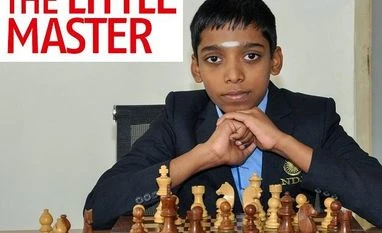 "How 12-year-old R Praggnanandhaa became India's youngest Chess Grandmaster")











