Nuclear war games: India thinks outside the box

Menon's book hints strongly that India could drop its 'no first use' policy under some circumstances
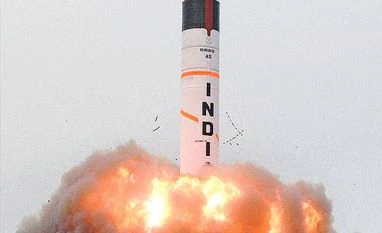
DRDO, missile launch
DRDO
Ajai Shukla New Delhi
Last Updated : Apr 11 2017 | 11:48 AM IST
The debate over India’s nuclear doctrine, which was first formulated in 1999 and revised in 2003, has centred mainly on whether India should abandon its doctrinal commitment of “no first use” — the undertaking not to use nuclear weapons unless India were attacked first with weapons of mass destruction — and the credibility of the so-called “massive retaliation”. But now, after former national security advisor Shivshankar Menon hinted strongly in his recent book that India could, in certain circumstances, launch pre-emptive nuclear strikes to knock out Pakistan’s nuclear arsenal, there is a noisy debate on the doctrine.

Menon himself has not clarified what precisely he meant in his book, “Choices: Inside the making of Indian foreign policy”. However, a group of young strategic experts in the US and UK have carefully parsed Menon’s words and convincingly argued that he has departed significantly from India’s traditionally restrained and reactive nuclear strategy. In its place, India’s former top nuclear Czar, an esteemed figure in strategic circles, has outlined a pro-active strategy that increases India’s nuclear options dramatically.

Vipin Narang, a strategist at the Massachusetts Institute of Technology, says Menon’s new strategy enables Indian planners, if convinced that Pakistan might be preparing a nuclear strike, to order wide-ranging nuclear strikes to take out that country’s nuclear arsenal, disregarding “no first use”. In essence, India might adopt a position of pre-emption rather than waiting to be struck with nuclear weapons. Narang’s interpretation of Menon’s words has evoked rapid-fire agreement from Shashank Joshi of the London-based Royal United Services Institution, Sameer Lalwani of the Stimson Centre, The New York Times, The Wall Street Journal, and others.
For Indian planners, this should open a heady conversation. Yet most Indian nuclear strategists and academics have long been wedded to the status quo and to formulaic recitations of the official doctrine, which was formulated at a time of vulnerability when New Delhi was countering post-nuclear-test sanctions through responsible behaviour. These Indian strategists argue, somewhat unconvincingly, that Menon has said nothing new.

Each side believes the other has an agenda. The status-quoists (mostly Indians) say the argument that Menon has expanded nuclear strike options is alarmist, and aims at creating grounds for non-proliferation activists to curb India. Those who see Menon’s views as path breaking allege that denial of a more pro-active Indian nuclear posture stems from the fear that more Nuclear Suppliers Group members might be alarmed into opposing India’ membership. 

Triggers for a war

According to traditional war-gaming scenarios, a nuclear crisis between India and Pakistan could be triggered by a damaging Pakistan-backed terrorist strike in India. To placate a seething Indian public, New Delhi would launch military offensives into Pakistan. Unable to halt the Indian strike corps with conventional forces and with defeat looming, Pakistani generals would order a “demonstration” strike on an Indian army column, in Pakistani territory, with tactical nuclear weapons: sub-kiloton nuclear warheads borne on the short-range Nasr missile which has a maximum range of 60 kilometres. The aim would be to cause limited damage (say 14-45 tanks destroyed and about 100 soldiers killed), warn India to withdraw and force Great Power intervention. 

However, New Delhi’s response to such a strike, going by its declared nuclear doctrine, is currently “massive” nuclear retaliation that causes “unacceptable damage” in Pakistan. Most strategists believe this obliges India to retaliate with full-strength nuclear weapons (15-100 KT) fired at multiple Pakistani cities, in what is termed counter-value strikes. It would cause casualties in the millions, but would leave intact much of Pakistan’s nuclear arsenal that is supposedly larger than India’s. 

Naturally, Pakistan would retaliate with massive counter-value strikes on Indian cities, imposing catastrophic destruction on our dense population centres.

How realistic is this? New Delhi’s established restraint in the face of Pakistani aggression — including Kargil in 1999, Parliament attack in 2001, and Mumbai terror strikes in 2008 — creates scepticism that New Delhi would deliver on the inherently non-credible threat of massive retaliation. Even Prime Minister Narendra Modi’s “surgical strikes” across the Line of Control last year were characterised by careful restraint.

Menon has now made massive retaliation more credible, by including options other than visiting Armageddon on innocent civilians. He writes: “If Pakistan were to use tactical nuclear weapons against India, even against Indian forces in Pakistan, it would effectively be opening the door to a massive Indian first strike… India would hardly risk giving Pakistan the chance to carry out a massive nuclear strike after the Indian response to Pakistan using tactical nuclear weapons. In other words, Pakistani tactical nuclear weapons use would effectively free India to undertake a comprehensive first strike against Pakistan (emphasis added).”

A “comprehensive first strike”, in nuclear warfare jargon, refers to a pre-emptive strike on the enemy’s nuclear arsenal —rather than cities — with the aim of disarming it. It has the moral virtue of not threatening the death of millions of innocent civilians and the strategic logic of disarming the adversary, making it both more credible and more responsible.

A policy of ambiguity

Menon is hardly the first Indian official to question NFU. In the 2003 doctrine, India expanded its nuclear retaliation options in two ways over the 1998 version. One, India would retaliate with nukes not just to a nuclear attack, but to an attack with any WMD: nuclear, chemical or biological. Two, an attack on Indian forces anywhere in the world (including inside Pakistan) would be regarded as an attack on India.

NFU’s further erosion continued through public pronouncements by serving and retired officials. In 2014, former strategic forces command chief, Lieutenant General BS Nagal, wrote an article suggesting NFU be replaced with a policy of ambiguity, leaving open the door for pre-emptive nuclear use. Nagal cited six reasons, including that India’s leadership would be morally wrong in placing its own populace in peril.

In November 2016, the then defence minister, Manohar Parrikar, stated: “India should not declare whether it has a NFU policy”. It was later clarified that this was his personal view. 

Now, Menon, known for his sobriety and restraint, has argued for pre-emptive first use:  “There is a potential grey area as to when India would use nuclear weapons first against another nuclear-weapon state. Circumstances are conceivable in which India might find it useful to strike first, for instance, against an NWS that had declared it would certainly use its weapons, and if India were certain that adversary’s launch was imminent. But India’s present nuclear doctrine is silent on this scenario.” Menon clearly believes that doctrinal silence allows the space for a pre-emptive strategy.

Rebuttals of this interpretation of Menon’s book have presented varied counter-arguments. Some of the more curious responses have included that Menon did not know what he himself meant by “comprehensive first strike”, which, for a strategic thinker of his sophistication, is downright insulting. Others claim that analysts are reading too much into two short paragraphs in Menon’s writings. But important nuclear strategies and doctrines have been presented in less space: India’s 2003 doctrine is only eight sentences; John Foster Dulles’ famous “massive retaliation” doctrine was contained within two short paragraphs; and, in December, President-elect Donald Trump signalled a major shift in America’s nuclear posture in 140 explosive characters.

Manpreet Sethi of the Centre for Air Power Studies and Rajesh Rajagopalan of the Jawaharlal Nehru University observe that a comprehensive counterforce strike would require an arsenal that India does not have: high-accuracy, nuclear-tipped missiles, nuclear targeting coordination and sophisticated intelligence, surveillance and reconnaissance capabilities to locate Pakistan’s nuclear weaponry. In fact, India is developing precisely these capabilities: a larger inventory of more accurate missiles, multiple independently targetable re-entry vehicles and a missile defence shield to guard high-value objectives against retaliatory Pakistani strikes. 

Sethi also argues that retaliation makes for a more credible doctrine than first use because the first use of a nuclear weapon is never an easy decision for any leader. In fact, a first strike against enemy nuclear forces might well be an easier decision than “massive retaliation” that kills millions of innocent civilians.
Rajagopalan also says new strategies being discussed might just be the “personal views” of people who have not considered the “serious problems that comes with a first strike or first use strategy.” This is hard to sustain about Menon, who is known to carefully weigh his words.

Are Menon’s radical new proposals just a cat’s paw, a trial balloon to assess reactions to Indian nuclear assertiveness? There is little to support that view. It would appear as if Menon, a creative thinker who realises the infirmities in India’s traditional nuclear doctrine, has interpreted it anew to create a wider menu of options for Indian decision-makers in a nuclear crisis. While declining comment on interpretations of his book, Menon revealingly commented: India’s current nuclear doctrine has far greater flexibility than it gets credit for.

One subscription. Two world-class reads.

Already subscribed? Log in

Subscribe to read the full story →
*Subscribe to Business Standard digital and get complimentary access to The New York Times

Smart Quarterly

₹900

3 Months

₹300/Month

SAVE 25%

Smart Essential

₹2,700

1 Year

₹225/Month

SAVE 46%
*Complimentary New York Times access for the 2nd year will be given after 12 months

Super Saver

₹3,900

2 Years

₹162/Month

Subscribe

Renews automatically, cancel anytime

Here’s what’s included in our digital subscription plans

Exclusive premium stories online

  • Over 30 premium stories daily, handpicked by our editors

Complimentary Access to The New York Times

  • News, Games, Cooking, Audio, Wirecutter & The Athletic

Business Standard Epaper

  • Digital replica of our daily newspaper — with options to read, save, and share

Curated Newsletters

  • Insights on markets, finance, politics, tech, and more delivered to your inbox

Market Analysis & Investment Insights

  • In-depth market analysis & insights with access to The Smart Investor

Archives

  • Repository of articles and publications dating back to 1997

Ad-free Reading

  • Uninterrupted reading experience with no advertisements

Seamless Access Across All Devices

  • Access Business Standard across devices — mobile, tablet, or PC, via web or app

Next Story



