When Sheetal Agarwal walks inside the childcare unit of the hospital along with her troupe, the parents wake the children from their slumber, “Utho! Wo aa gaye. (Wake up! They have arrived.)” Instantly, laughter erupts at one bed and spreads in the ward. She is a clownselor, a wordplay on a clown and a counsellor, who does medical clowning along with a group of 18-20 volunteers. Medical clowning is said to help in healing and is routinely used in the West as a medical aid.
“Many children don’t react well to the pain during their treatment and are unable to recuperate. Through humour, we get them to feel things again,” says Rehana Quazi, a group member. It all started when Agarwal met a person who did medical clowning in Gujarat’s Vadodara. Back in Delhi, she could find none and so she decided to become one. Agarwal started visiting hospitals every Saturday in July 2016, but left her job in 2018 to do this full time. “The first day I did this, I was smile hungover for a week. Till now, almost 170 people have clowned with me,” she says.
Ekta Sansi, another member of Clownselors adds, “You don’t associate a hospital with happiness. But this has helped me experience that you can do something positive in any environment”. Agarwal has given a TEDx talk on the subject and conducts awareness programmes with skits, puppet shows, and games for children and the elderly. Earning their trust is the most difficult yet the most fulfilling part. Sometimes the parents are apprehensive but even they need to lighten up so we include them in our games, she says.
Playing is the favourite pastime of Pista and Kaju too. These two canines were rescued by Harsha Vats, who started Tiny Tails, a shelter for stray dogs.
“When I found Pista, she was suffering from a type of bloody diarrhoea. After treatment, I did not want to leave her on the street, so Tiny Tails came into existence. Now it houses 29 dogs,” Vats says. Her team consists of seven people and the project costs Rs 35,000-Rs 40,000 a month. While funding remains an issue, veterinary doctors who would provide affordable healthcare remain elusive, she said. “It’s good that people help by donating dog food. I get all my dogs sterilised, so it's easier for people to adopt them,” she added.
Sheetal Agarwal of clownselors who does medical clowning along with a group of 18-20 volunteers
What connects Clownselors and Tiny Tails is Socio Story (SS). It is a platform which brings idea generators and social sector investors in one room. Avadhesh Dixit, Chief mentor of SS, describes their role thus. “We have to discover, help them (changemakers) narrate their story and get them recognised. The biggest responsibility is making a name as a credible entity in the field of social responsibility”.
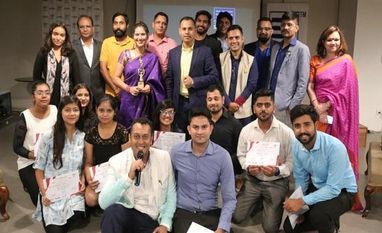
After people submit their ideas, Socio Story prunes the list and invites the top changemakers to present their ideas to investors in person. Ideas of the rest are shown in a documentary, due to time constraints of a physical event.
Manoj Pachauri, one of the co-founders of SS agrees. “We have to find the people, talk to the block development officials for a list of NGOs, help them file for funding. Even choosing an investor depends on spending patterns. One investor might focus on the education sector, while another may focus on healthcare,” he adds.
So they did in the case of Solecraft, a textile upcycle venture which transforms used denim into a school kit consisting of a school bag, a pair of shoes and a pencil box. Partnering with local cafes in Jodhpur, Rajasthan, Solecraft collects used denim fabrics. Once cleaned, dried and ironed, it is sent to their factory. The thicker fabric is made into yoga mats, or duffel bags for their commercial venture while the finer one is used to make pencil boxes. They donate the school kits free of cost.
Last year they had presented their idea at SS. The platform, SS, aims to branch out into a virtual incubation centre, which can provide assistance and guidance to changemakers online, in the coming years. They are also planning skill development workshops with various institutes of social sciences.
Prajjawal Deepraj, who looks after the technology net of SS, says, “We are just the facilitators who are matchmaking the social sector changemakers with those who wish to invest”. Their next event is on December 14.




