2 min read Last Updated : Nov 23 2020 | 12:56 PM IST
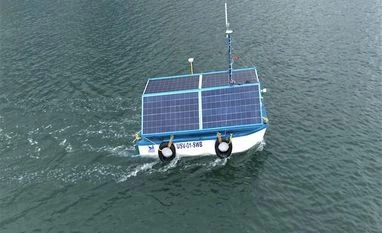
Researchers at the Indian Institute of Technology (IIT), Madras, have developed a solar-powered unmanned autonomous survey craft for Indian ports and inland waterways. The craft can undertake autonomous hydrographic and oceanographic surveys and provide real-time data transmission over long distance.
This system can also be equipped with an echo sounder, GPS System and broadband communication technology, to deliver precise depth measurements.
In addition to the echo sounder and GPS system, it is possible to add additional oceanographic payloads (current and velocity measurements), 360-degree camera LiDAR for seamless topography and bathymetry measurements.
The craft was recently tested successfully off the Chennai Coast at Kamarajar Port. Further field trials under harsher environments have been scheduled during November 2020 at Syama Prasad Mookerjee (SMP) Port, Kolkata.
The autonomous survey craft was developed by a research team at the National Technology Centre for Ports, Waterways and Coasts (NTCPWC) at IIT Madras. The researchers are already in the process of commercialising this technology with the help of the Ministry of Shipping and IIT Madras Incubation Cell.
Highlighting the major impact of developing thisaAutonomous survey craft, Prof K Murali, professor in-charge, NTCPWC, IIT Madras, said, “This is a significant leap towards indigenisation of the Indian maritime sector, which is currently dominated by foreign technology. The craft is capable of delivering precise and accurate depth measurements even in very shallow waters. This autonomous survey craft will help meet the increasing demands for volume and efficiency as ships become larger, with maximum loading to ensure most efficient operations.”
Professor Murali, who is also the Head, Department of Ocean Engineering, IIT Madras, added, “The craft can undertake autonomous hydrography surveys at different times of the day to identify the navigable paths that can be used for operational window and navigational guidance. It has been developed to carry out survey operations in areas such as ports, harbours, waterways, dams, lakes, lagoons and other shallow water zones. It can be operated in manual mode by a remote-control setup or as a fully autonomous vehicle.”
The craft is fully solar-powered and can work for several hours depending on user requirements.
The development of the survey craft is part of the research funding provided to the NTCPWC by the Ministry of Shipping. In addition, it can help is dealing with some challenges that are frequently encountered by port administrators in India.