India jumps 19 spots in logistic performance
World Bank report says India, ranked 35th, 'overperformed' its income group
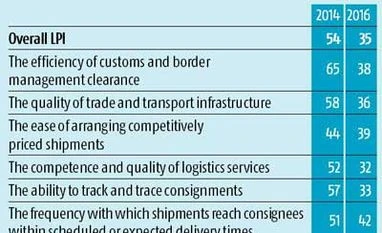
Jyoti Mukul New Delhi Improvement in services for exporters has pushed the country 19 places higher in the World Bank group's Logistics Performance Index (LPI). Among 160 countries, it stood at 35, based on six criteria that impact export shipment.
The LPI has been prepared by the bank's trade and competitiveness group every two years since 2007. India's overall LPI score rose from 3.07 in 2014 to 3.42 in 2016, of a maximum five. The first country Germany, while the last in Syria.
Though China outshines India at 27, it stands higher in order compared to several upper-middle income countries and BRICS members. Brazil ranks 55, Indonesia 63 and Russia is 99. The report, in fact, said India "overperformed" its income group.
The parameters include efficiency of customs and border management clearance, quality of trade and transport infrastructure, ease of arranging competitively priced shipments, competence and quality of logistics services, ability to track and trace consignments and frequency with which shipments reach consignees within scheduled or expected delivery times.
The components are chosen based on theoretical and empirical research, and on the practical experience of logistics professionals involved in international freight forwarding.
These six LPI indicators are grouped in two main categories of areas for policy regulation, indicating main inputs to the supply chain (customs, infrastructure, and services). Second, supply chain performance outcomes (corresponding to indicators of time, and timeliness, international shipments, and tracking and tracing).
The findings were released globally late Wednesday and are based on a survey of about 1,200 logistics professionals worldwide and covers 160 countries. Supported by the International Federation of Freight Forwarding Associations (FIATA).
Progress in India reflects balanced improvements in policies that facilitate connectivity (in Customs, for example) and improve hard trade-and transport-related infrastructure.
Though the LPI is biased towards the performance of the main economic gateways in the country, it also captures the extent of costs and inefficiency in moving goods internally, especially across states where internal barriers are known to exist.
Officials said the improvement in ranking results from reduction in the documentation required for shipping from seven to three. Besides, reducing the coverage of Risk Management System for Customs inspection to 30 per cent from 100 per cent has helped.
The report said lack of regional integration impacted logistics movement between neighbouring countries. This has resulted in a situation where North Africa and West Asia were doing worse than what their income level would indicate. Similarly, in South Asia, lack of integration results in good performance by India not improving that of its neighbours.

 "India jumps 19 spots in logistic performance")


 Connect with us on WhatsApp