India records over 6,500 new Covid-19 cases in 24 hrs, death toll at 4,167

Confirmed cases surge past 145,000; fatality rate down from 3.3% to 2.87%

coronavirus, lockdown, traffic, people, police, curfew
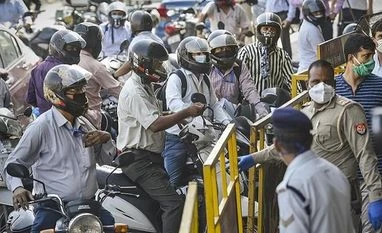
New Delhi: A police constable stops commuters to cross Delhi-Ghaziabad border after it was sealed by the authorities due to a sudden surge in coronavirus cases in the national capital, during the ongoing COVID-19 lockdown, in New Delhi.
Ruchika Chitravanshi New Delhi
4 min read Last Updated : May 27 2020 | 3:01 AM IST
India recorded an increase of more than 6,500 cases and 146 deaths in a single day, taking the total tally of confirmed cases to more than 145,000 and 4,167 deaths as of Tuesday morning, even as the fatality rate improved to 2.87 per cent, revealed the health ministry data.

With Covid-19 cases continuing to increase rapidly, there have been questions around whether India was in the community transmission stage.

Balram Bhargava, director general, Indian Council of Medical Research (ICMR), however, maintained, “We have clear-cut containment areas, which are being tackled and studied. Seroprevalence (the level of a pathogen in a population, as measured in blood serum) is being studied. Before that (is done), it is not wise to comment.”

Bhargava also said India is now testing over 100,000 samples in a day across 612 laboratories, of which 182 are private.


The health ministry said India’s recovery rate has crossed 41 per cent, with 60,490 patients cured. Fatality, according to the health ministry, has also improved to 2.87 per cent, from 3.3 per cent in April, against the global average of 6.4 per cent.  

“Globally, 69.9 cases per 100,000 have been reported. In India, it is only 10.7 positive cases per 100,000. This is despite our density of population and limitation of resources, compared to other countries,” said Lav Aggarwal, joint secretary, health ministry.

On the use of hydroxycholoroquine (HCQ), the ICMR has said the drug is being recommended for use as a preventive measure for front line health workers after a risk-benefit analysis of the drug. “There is no harm in taking the drug. There may be a benefit. We don’t want to deprive our health workers of it,” said Bhargava.


He said the use of the drug was recommended after studying its biological plausibility and in-vitro tests that suggested that HCQ had antiviral drug properties. There were no major side-effects of taking the drug, except nausea and palpitations in some cases. The ICMR has said those taking the drug must get an electrocardiogram done and also consume it with food.

The World Health Organization had temporarily suspended allocation of patients in the HCQ arm of the solidarity trial.  

Health Secretary Preeti Sudan also held a high-level review meeting via videoconference with officials of Uttar Pradesh (UP), Chhattisgarh, Bihar, and Madhya Pradesh (MP) on Tuesday after a surge in cases was observed in the last three weeks in the four states since lockdown rules were eased and interstate migration allowed.

Confirmed cases of Covid-19 have more than doubled in these states since the lockdown was relaxed on May 4. In UP and MP, the number has gone up from close to 3,000 on May 4 to 6,532 and 6,849, respectively, as of Tuesday morning.

In Bihar, the cases have increased multifold from around 500 to over 2,700 in the same period.


In a meeting held with chief secretaries, health secretaries, and National Health Mission directors of these states, the health ministry emphasised that each containment zone has to be analysed to check the trends and adopt course correction measures through proper formation and implementation of micro-plans.

“The states were asked to assess the existing health infrastructure in terms of quarantine centres, hospitals with intensive care unit, ventilator and oxygen beds, and strengthen them looking at the need for the next two months,” said a press statement.
 
ICMR removes price cap of Rs 4,500 for coronavirus tests

The Indian Council of Medical Research has removed the price cap of Rs 4,500 for the real-time polymerase chain reaction (RT-PCR) test used to detect Covid-19, asking states and UTs to negotiate with private labs to fix “mutually agreeable” rates for the test.        PTI


One subscription. Two world-class reads.

Already subscribed? Log in

Subscribe to read the full story →
*Subscribe to Business Standard digital and get complimentary access to The New York Times

Smart Quarterly

₹900

3 Months

₹300/Month

SAVE 25%

Smart Essential

₹2,700

1 Year

₹225/Month

SAVE 46%
*Complimentary New York Times access for the 2nd year will be given after 12 months

Super Saver

₹3,900

2 Years

₹162/Month

Subscribe

Renews automatically, cancel anytime

Here’s what’s included in our digital subscription plans

Exclusive premium stories online

  • Over 30 premium stories daily, handpicked by our editors

Complimentary Access to The New York Times

  • News, Games, Cooking, Audio, Wirecutter & The Athletic

Business Standard Epaper

  • Digital replica of our daily newspaper — with options to read, save, and share

Curated Newsletters

  • Insights on markets, finance, politics, tech, and more delivered to your inbox

Market Analysis & Investment Insights

  • In-depth market analysis & insights with access to The Smart Investor

Archives

  • Repository of articles and publications dating back to 1997

Ad-free Reading

  • Uninterrupted reading experience with no advertisements

Seamless Access Across All Devices

  • Access Business Standard across devices — mobile, tablet, or PC, via web or app

Topics :CoronavirusLockdownHealth MinistryHydroxychloroquineWorld Health OrganisationUttar PradeshBiharChattisgarhMadhya Pradesh

Next Story