India requires a National Salt Policy to achieve 100% USI: Experts
Country has achieved 71% Universal Salt Iodisation
BS Reporter Ahmedabad India requires a National Salt Policy to achieve 100 per cent Universal Salt Iodisation (USI) and to address the numerous issues faced by the salt industry, industry experts said here on Monday at the India Salt Summit 2015.
"India requires a comprehensive National Salt Policy which addresses the issues faced by salt industry. For India to achieve 100 per cent USI, a national level policy is a must," said, M A Ansari, former Salt Commissioner of India.
Similar views were echoed by P N Rao, senior general manager (commercial), GHCL Limited; Rizwan Yusufali, manager, Salt Iodization Programme, Global Alliance for Improved Nutrition (GAIN); Kapil Yadav, assistant professor, Indian Coalition for Control of Iodine Deficiency Disorders (ICCIDD), All India Institute of Medical Sciences (AIIMS) and other panellists.
Currently, 71 per cent of Indian households consume salt with adequate iodine content while 20 per cent consume salt with certain amount of iodine deficiency while the remaining nine per cent contain salt without any iodine content, according to the experts. Worldwide, 76 per cent households consume salt with adequate iodine content, according to GAIN.
Rajan Sankar, country manager and senior advisor, South Asia, GAIN admitted that rural poor in India are still not getting salt with required iodine content.
"Rural poor across the country are not getting salt with required iodine content. Effort is being made to collaborate salt manufacturers and consumers who are not getting salt with required iodine content," Sankar said.
At the summit, I K Jadeja, executive chairman, Swarnim Gujarat committee, inaugurated India Salt Services Cooperative Federation (ISSCF), a body comprising salt manufacturers, wholesalers, retailers and other industry sectors.
This federation, Sankar said, will provide platform to iodised salt manufacturers not having access to all consumers and vice-versa.
"A comprehensive document proposing Technology Upgradation Fund Scheme (TUFS) for salt sector, on the lines of one for textile sector, and for framing Salt Policy will be created by stakeholders of the industry after the Summit, which will later on be submitted to Central government and respective state governments," said Sankar.
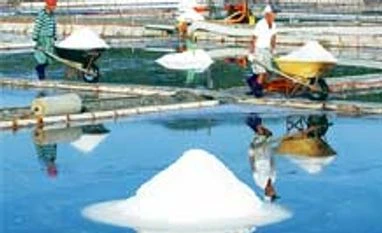
Experts also urged the government to improve logistics to augment exports in addition to easing land lease renewal for salt producers. Thrust was also given on improving skills of salt pan workers and upgrading technology for increasing salt output.
The average annual production of salt in India is 21.58 million tones. Gujarat, Tamil Nadu and Rajasthan account for about 96 per cent of the country’s salt production.

 "India requires a National Salt Policy to achieve 100% USI: Experts")


 Connect with us on WhatsApp