India and Russia on Thursday signed the much-awaited agreement on setting up of two more units of a nuclear power plant in Tamil Nadu and decided to give a “new direction” to the defence cooperation between the two “great powers”.
The two countries also decided to hold the first tri-services exercises, named ‘Indra-2017’, this year and start joint manufacturing of frigates, adding on to the co-production of Kamov-226 military helicopters.
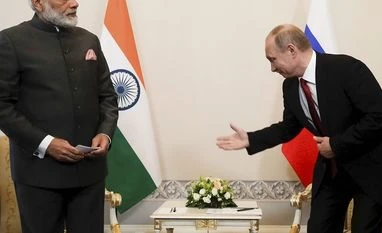
These decisions were taken at the wide-ranging talks between Prime Minister Narendra Modi and Russian President Vladimir Putin here, which covered a range of issues, including terrorism and increasing trade and investment.
Addressing the media jointly with Putin, Modi said the relations between India and Russia have been unwavering, based on “mutual love, respect and strong trust”.
“From culture to security, our relations have been on a par ... We speak in one language,” he said.
He said the two leaders had decided to speed up the bilateral cooperation in all fields, for which an ‘action plan’ has been devised.
Noting that India and Russia were celebrating the 70th anniversary of their relations, Modi said there had been no impact on the ties in all these decades.
Putin described the talks as substantive and said the India-Russia “partnership was developing into a strategic and privileged one.”
A joint declaration issued after the talks said “the Indian-Russian special and privileged strategic partnership was a unique relationship of mutual trust between the two great powers.”
It said the relationship covered all areas of cooperation, including in the spheres of political relations, security, trade and economy, military and technical field, energy, scientific, cultural and humanitarian exchanges, and foreign policy.
The relationship helps promote national interests of both countries, and contributes to the establishment of a more peaceful and just world order, the declaration said.
The two sides signed five agreements, which included one on setting up of units 5 and 6 of the Kudankulam Nuclear Power Plant in Tamil Nadu.
Modi said the nuclear agreement, which was a major outcome of the summit meeting, would further strengthen the ties between the two countries.
The other pacts included a contract for a high-speed train service between Nagpur and Secunderabad, a memorandum of understanding (MoU) for export of precious stones and jewellery and a programme on cultural exchanges.
“We welcome the conclusion of the the general framework agreement and credit protocol for units 5 and 6 of the Kudankulam Nuclear Power plant,” according to a ‘Vision Document’ issued after the talks.
The reactors will be built by India’s Nuclear Power Corporation of India (NPCIL) and Russia’s Atomstroyexport company, a subsidiary of Rosatom, the regulatory body of the Russian nuclear complex. Each of the two units will have a capacity to produce 1,000 megawatt (MW) of power.
The document titled ‘A vision for the 21st Century’ said economies of India and Russia complemented each other in the energy sector and both countries would strive to build an “energy bridge”.
It said the future of Indian-Russian cooperation holds great promise across a wide spectrum covering nuclear power, nuclear fuel cycle and nuclear science and technology.
“We will strive to build an ‘energy bridge’ between our states and expand bilateral relations in all areas of energy cooperation, including nuclear, hydrocarbon, hydel and renewable energy sources and in improving energy efficiency,” it said.
The growing partnership in the nuclear power sector between India and Russia has opened opportunities for developing advanced nuclear manufacturing capabilities in India in line with its “Make In India” initiative, the declaration said.
India and Russia commit themselves to earnestly implement the “Programme of Action for Localisation in India” signed on December 24, 2015, and to encourage their nuclear industries to engage closely and foster concrete collaborations, it said.
The current nuclear power generation capacity of all 22 nuclear power reactors is 6,780 MW.
In October 2015, a joint statement between Modi and Putin promised the signing of a global framework agreement on nuclear units by December 2016. After an inter-ministerial group cleared the project, it was sent to the Prime Minister’s Office for approval. But, sources said, the credit protocol, or a line of credit that Russia was to provide, proved to be a hurdle.
The two countries also said there had been a “steady and demonstrable” achievements in bilateral civil nuclear partnership, including advancing nuclear power projects at the Kudankulum site and transforming it into one of India’s largest energy hubs. “Cooperation in the peaceful uses of nuclear energy has emerged as one of the hallmarks of the strategic partnership between the two countries, contributing to India's energy security and energising broader scientific and technological cooperation,” the document said.
Talking about terrorism, Modi said the views of the two countries are similar on the problem in whichever form it exists, whether in Afghanistan, Middle East or Asia-Pacific.
"India and Russia stand together on terrorism and new challenges to the security," he said.
In the joint statement, the two sides said that the "unprecedented spread" of the threat of terror "requires decisive collective response on part of the entire global community, without double standards and selectivity, in accordance with international law and the UN Charter." It added,
"We urge all countries and entities to work sincerely to disrupt terrorist networks and their financing, and stop cross-border movement of terrorists." The two countries called for early conclusion of negotiations on the Comprehensive Convention on International Terrorism to strengthen the global counter-terrorism normative and legal framework to combat this scourge.
Referring to trade, Modi said the two countries were close to achieving the target of $30 billion by 2025. At present, trade between the two nations stands at $7.8 billion, down from $10 billion in 2014. Russian investment in India is $4 billion while Indian investment in Russia is $8 bn, Putin noted.
Modi will be addressing a large gathering of business leaders tomorrow at the St Petersburg International Economic Forum (SPIEF), where India is the guest country for the first time. The prime minister said it was a privilege for him.

 "Modi in Russia: 2 more units at Kudankulam nuclear plant under new pact")


