The recently published Global Hunger Index (GHI) report says, “It is difficult to be optimistic about hunger in 2021.” And that’s an observation that applies to the entire world.
Though the GHI score for the world has fallen consistently in the last two decades, the pace of hunger eradication has slowed down in the last few years. The World GHI score fell from 28 in 1998-2002 to 25.1 in 2004-2008,to 20.4 in 2010-2014 and 17.9 in 2016-2020.
However, there are concerns that globally, the prevalence of undernourishment, or insufficient calorie intake, has risen in the last two years. And India is no exception.
Quick methodology The four indicators used in calculating the GHI score are: The proportion of undernourishment — insufficient calorie intake; child mortality — percentage of children who die before turning five; prevalence of stunting — low height for age; and prevalence of wasting — low weight for height.
These parameters are in different units and not comparable to each other. In order to club them, they are standardised by giving a ceiling/floor to each parameter, and then converting the absolute value for a country to a value relative to the ceiling/floor.
The score is arrived at by taking the weighted average of the four parameters, in weights ratio 33.3:33.3:16.67:16.67 respectively, in the order mentioned above.
The final score lies between 0 and 100, zero being the best outcome possible in the current state of global hunger and 100 being the worst.
Fall in rank is relative to others While India’s position has slipped in the GHI rank, its overall GHI score has actually improved in the last few years — from 28.8 to 27.5. Lower score translates to lower hunger.
The fall in ranking is thus relative. It means that despite India’s improvement in score, many other countries made faster improvements in the last few years.
For instance, Ethiopia was behind India in the period 2010-2014, with a GHI score of 33.5. It is now ahead of India, with the score at 24.1. North Korea also moved up — from 29.1 to 25.2.
Gains and losses in absolute terms
Two of the four GHI indicators have worsened and two have improved for India. But what do these changes mean in absolute terms?
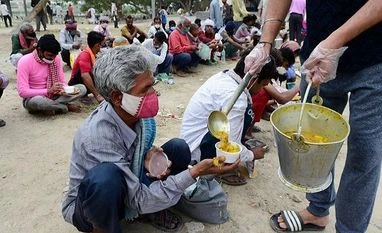
According to the report, the proportion of the undernourished in the country has increased from 15 per cent to 15.3 per cent of the population. Although this looks marginal in percentage terms, it translates to more than an additional 4 million people.
Also, the prevalence of children who have low weight for their height has increased massively — from 15.1 per cent to 17.3 per cent.
At the current level of projected population, this means that the number of wasted children in India went up from 17.2 million to 19.7 million in the span of a few years (considering that 0-4 year olds make up 114 million of India’s population).
However, stunting is slowly coming under control. Using the same population proxy, India has been successful in saving 4 million kids from the scourge of stunting and saved nearly 2 million kids under five years from dying.
The problem of nutrition
While describing the high variation in the range of values across countries, the GHI report says: “For some countries, high scores are driven by high rates of undernourishment, reflecting a lack of calories for large swathes of the population. For others, high scores result from high levels of child wasting, reflecting acute undernutrition; child stunting, reflecting chronic undernutrition; and/or child mortality, reflecting children’s hunger and nutrition levels.”
The latter is a major problem for India.
The country boasts of implementing the world’s biggest food security programme. But even so, India falls behind on nutrition, which is key for complete human nourishment. Business Standard looked at data from six countries to ascertain India’s situation.
India is 40 per cent below the global average vegetable consumption. An average Indian consumes 80 kg of vegetables in a year, compared to 140 kg globally, according to OurWorldInData, a global data repository.
Fruits are another category of nutritious food, and India falls 30 per cent behind the world here. The average Indian eats 56 kg of fruit per year, compared to 78 kg globally. India falls to sixth place among the small group analysed here.
“In the majority of safety net schemes, the focus is mostly on providing a cereal-based diet, thus lacking in diet diversity, with minimal use of food groups like millets, pulses, vegetables and dairy,” Neha Pathania, senior nutritionist, Paras Hospitals, Gurugram, told Business Standard.
The trend is similar in meat consumption, too. An average Indian consumes 3.78 kilograms of meat in one year! In Vietnam, with similar levels of GDP per capita as India, meat consumption is a whopping 15 times higher.
In Nigeria, it is 7.15 kg, whereas in Indonesia, meat consumption stands at 11.7 kg per year. Bangladesh, too, has a higher meat intake than India — 4.04 kg per person per year, according to OurWorldInData.

 "India saves 2 mn kids from dying, but 4 mn people go below nourishment line")











