India to emerge as key military partner in US' plan to counter China's rise

The document lays out a vision for the region in which North Korea no longer poses a threat, India is predominant in South Asia and the U.S. works with partners around the world to resist Chinese acti

China, Xi Jinping
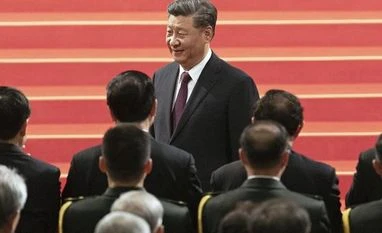
Chinese President Xi Jinping is moving swiftly to foil perceived threats to the Communist Party. (Photo: Bloomberg)
Philip J. Heijmans and Iain Marlow | Bloomberg
5 min read Last Updated : Jan 13 2021 | 11:53 PM IST
The Trump administration declassified its strategy to ensure continued dominance over China, which focuses on accelerating India’s rise as a counterweight to Beijing and the ability to defend Taiwan against an attack.

National Security Advisor Robert O’Brien on Tuesday announced the publication of the document, titled “United States Strategic Framework for the Indo-Pacific.” Approved by President Donald Trump in February 2018, it provided the “overarching strategic guidance” for U.S. actions the past three years and was released to show the U.S. commitment to “keeping the Indo-Pacific region free and open long into the future,” O’Brien said in a statement.

“Beijing is increasingly pressuring Indo-Pacific nations to subordinate their freedom and sovereignty to a ‘common destiny’ envisioned by the Chinese Communist Party,” O’Brien said in an expanded statement. “The U.S. approach is different. We seek to ensure that our allies and partners – all who share the values and aspirations of a free and open Indo-Pacific -- can preserve and protect their sovereignty.”

The document lays out a vision for the region in which North Korea no longer poses a threat, India is predominant in South Asia and the U.S. works with partners around the world to resist Chinese activities to undermine sovereignty through coercion. It assumed that China will take “increasingly assertive” steps to compel unification with Taiwan and warns that its dominance of cutting-edge technologies like artificial intelligence will “pose profound challenges to free societies.”

While the timing of the release just a week before President-elect Joe Biden takes office raises questions about the motive, the Trump administration’s actions to counter China in Asia have largely enjoyed bipartisan support. Incoming Biden officials have talked about the need to work more with allies and partners against China, which also forms a key part of the strategy -- particularly in strengthening security ties with Australia, Japan and India.

Rory Medcalf, a professor and head of the National Security College at the Australian National University, said that the document shows U.S. policy in Asia was driven by efforts to “bolster allies and counter China.” But he noted that the strategy was so ambitious that “failure was almost assured” on issues such as disarming North Korea, sustaining “primacy” in the region and finding international consensus against harmful Chinese economic practices.

“The declassified framework will have enduring value as the beginning of a whole-of-government blueprint for handling strategic rivalry with China,” Medcalf wrote in a post for the Australian Strategic Policy Institute research group. “If the U.S. is serious about that long-term contest, it will not be able to choose between getting its house in order domestically and projecting power in the Indo-Pacific. It will need to do both at once.”

Key highlights of the report include:

China

* Assumes China “aims to dissolve U.S. alliances and partnerships in the region. China will exploit vacuums and opportunities created by these diminished bonds.”

* “China seeks to dominate cutting-edge technologies, including artificial intelligence and bio-genetics, and harness them in the service of authoritarianism. Chinese dominance in these technologies would pose profound challenges to free societies.”

* “China will take increasingly assertive steps to compel unification with Taiwan.”

Act to “counter Chinese predatory economic practices that freeze out foreign competition, undermine U.S. economic competitiveness, and abet the Chinese Communist Party’s aspiration to dominate the 21st century economy.”

* “Build an international consensus that China’s industrial policies and unfair trading practices are damaging the global trading system.”

* “Work closely with allies and like-minded countries to prevent Chinese acquisition of military and strategic capabilities.”

India

* Desired outcome: “India’s preferred partner on security issues is the United States. The two cooperate to preserve maritime security and counter Chinese influence in South and Southeast Asia and other regions of mutual concern.”

* “India remains preeminent in South Asia and takes the leading role in maintaining Indian Ocean security.”

* “Accelerate India’s rise and capacity to serve as a net provider of security and Major Defense Partner; solidify an enduring strategic partnership with India underpinned by a strong Indian military.”

* “Strengthen the capacity of emerging partners in South Asia, including the Maldives, Bangladesh, and Sri Lanka, to contribute to a free and open order.”

Taiwan

* “Devise and implement a defense strategy capable of, but not limited to: (1) denying China sustained air and sea dominance inside the “first island chain” in a conflict; (2) defending the first-island-chain nations, including ·Taiwan; and (3) dominating all domains outside the first island-chain.”

* “Enable Taiwan to develop an effective asymmetric defense strategy and capabilities that will help ensure its security, freedom from coercion, resilience, and ability to engage China on its own terms.”

North Korea:

* Objective: “Convince the Kim regime that the only path to its survival is to relinquish its nuclear weapons.”

* “Maximize pressure on Pyongyang using economic, diplomatic, military, law enforcement, intelligence, and information tools to cripple North Korea’s weapons of mass destruction programs, choke off currency flows, weaken the regime, and set the conditions for negotiations aimed at reversing its nuclear and missile programs, ultimately achieving the complete, verifiable, and irreversible denuclearization of the Peninsula.”

* “Do this by: (1) helping South Korea and Japan acquire advanced, conventional military capabilities; (2) drawing south Korea and Japan closer to one another.”

Southeast Asia

* Objective: “Promote and reinforce Southeast Asia and Asean’s central role in the region’s security architecture, and encourage it to speak with one voice on key issues.”

* “Promote an integrated economic development·model in the Indo-Pacific that provides a credible alternative to One Belt One Road; create a task force on how best to use public-private partnerships.”

One subscription. Two world-class reads.

Already subscribed? Log in

Subscribe to read the full story →
*Subscribe to Business Standard digital and get complimentary access to The New York Times

Smart Quarterly

₹900

3 Months

₹300/Month

SAVE 25%

Smart Essential

₹2,700

1 Year

₹225/Month

SAVE 46%
*Complimentary New York Times access for the 2nd year will be given after 12 months

Super Saver

₹3,900

2 Years

₹162/Month

Subscribe

Renews automatically, cancel anytime

Here’s what’s included in our digital subscription plans

Exclusive premium stories online

  • Over 30 premium stories daily, handpicked by our editors

Complimentary Access to The New York Times

  • News, Games, Cooking, Audio, Wirecutter & The Athletic

Business Standard Epaper

  • Digital replica of our daily newspaper — with options to read, save, and share

Curated Newsletters

  • Insights on markets, finance, politics, tech, and more delivered to your inbox

Market Analysis & Investment Insights

  • In-depth market analysis & insights with access to The Smart Investor

Archives

  • Repository of articles and publications dating back to 1997

Ad-free Reading

  • Uninterrupted reading experience with no advertisements

Seamless Access Across All Devices

  • Access Business Standard across devices — mobile, tablet, or PC, via web or app

Topics :India China relationsUS ChinaIndian Army

Next Story





