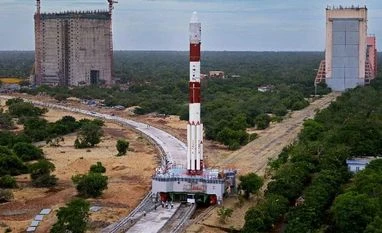
Indian Space Research Organsiation's (Isro) attempt to launch India's eighth navigation satellite IRNSS-1H failed today. While the rocket took off successfully, the heat shield did not separate as planned due to which satellite could not be put in orbit. This is the first failure in 35 launches for Isro's workhorse Polar Satellite Launch Vehicle PSLV.
Since heat shield did not open on PSLV-C39, satellite got trapped, thus making the launch unsuccessful.
After the 29-hour countdown, Polar Satellite Launch Vehicle (PSLV-C39) carrying the 1425-kg navigation satellite IRNSS-1H blasted off from the second launch pad at Sriharikota in Andhra Pradesh at 7 p.m. as scheduled.
Till around 20 minutes the flight was performing normal, but when it came to the stage of heat shield separation the launch turned unsuccessful.
A S Kiran Kumar, chairman, Isro said that the heat shield has not separated. "The satellite is inside the heat shield and we have to go through a detailed analysis to see what has happened. Apart from the heat shield separation, all the rest of the activities has gone on smoothly, but in terms of the mission, it is unsuccessful because we are not in a position to put it to the actual orbit," he said.
"We will do the detailed analysis and come on this," he added.
Since 2013, Isro has launched seven navigation satellites. The last one was launched on April 28, 2016. Each satellite has a life span of 10 years.
The satellite, which was launched today, suppose to replace IRNSS-1A as its rubidium atomic clocks have failed. It may be noted, the clocks are important to provide the accurate positional data.
The Rs 1,420 crore Indian satellite navigation system NavIC consists of nine satellites -- seven in orbit and two as substitutes. One of the substitutes is the IRNSS-1H.
Like its other IRNSS predecessors, IRNSS-1H was supposed to carry two types of payloads – navigation payload and ranging payload. The payload will transmit navigation service signals to the users and they will be operating in L5-band and S-band.
The ranging payload of IRNSS-1H consists of a C-band transponder, which facilitates accurate determination of the range of the satellite. IRNSS-1H also carries Corner Cube Retro Reflectors for laser ranging.
According to Isro, NavIC is useful for fishermen to reach the potential fishing area. The fishermen can also get alert messages relating to bad weather, high waves or when they approach international maritime boundary line.
These services are provided through a software application on a smartphone and it will help merchant ships in their navigation and also during search and rescue operations.
In the road transport sector, NavIC helps commuters from going one place to another and also enable transport operators to track their vehicles.
According to experts, NavIC provides two types of services -- standard positioning service and restricted service. The fully operational system is expected to provide accurate position information service to users across the country and the region, extending up to an area of 1,500 km.
Isro said that the navigation system is also helpful for railways in tracking trains and also giving an alert in the case of unmanned level crossing and it can be used for other applications including location based services, survey and alignment, time synchronised services.
Private sector did 25% of development work of IRNSS-1H
IRNSS-1H has been developed by Indian Space Research Organisation (ISRO) jointly with the private sector. The first of its kind initiative was part of ISRO's plans to enable the industry to take part in the country's space revolution, which would also help the organisation to speed up the launches.
A consortium led by Bengaluru-based Alpha Design Technologies successfully completed 25 per cent of the development work of IRNSS-1H, under the guidance of ISRO scientists. Earlier, the private sector's role was only limited to supplying components to ISRO.
"This is a new beginning for the private sector," said Dr Mylswamy Annadurai, Director, ISRO's Satellite Centre (ISAC), he was quoted as saying. He said his colleagues provided on-the-job training for 70-odd engineers of a consortium led Alpha Design Technologies Ltd on integration and testing of the satellite.
A similar satellite has been planned to be made to ISRO's exacting standards by the same consortium by April 2018 but with less support from ISRO's engineers and technicians.