Known for his bright turbans, tailor-made suits and eloquence, 38-year-old Jagmeet Singh, a criminal lawyer-turned-politician, was recently posed a rude question. Singh was in his home state of Ontario ahead of being elected as the first non-white leader of a major political party in Canada, when he was confronted by a hysterical white woman in the middle of his speech at an event he called “Jagmeet and Greet”. “When is your Sharia going to end?” yelled the woman, referring to a conservative interpretation of Islam, as she charged at Singh.
Singh smiled in response to the woman’s intimidations as the crowd was left dumbfounded by her ignorance.
At over six feet tall, Singh is the Canadian son of an immigrant couple from Punjab who rose to become the first turban-wearing Sikh provincial legislator from Ontario. This feat followed his fame as a fiery criminal defence lawyer who had fought for social justice and rights of immigrants.
“Thank you New Democrats, the race for Prime Minister begins now,” Singh tweeted last week amid worldwide attention for his first ballot victory that makes him the leader of the New Democratic Party. He will now challenge the incumbent prime minister, Justin Trudeau, for the top job in 2019 — simultaneous to when India goes to national polls.
Despite being of Indian descent, Singh does not please the old brand of politicians in his ancestral country. So much so that in December 2013, he was denied a visa to visit India. This was the first time the Indian government had denied entry to a legislator from the West. Expectedly then, despite the Indian and world media going gaga over Singh’s latest achievement, no congratulatory messages flew in from the left-, right- or centre-aligned Indian politicos.
The reason is Singh’s harsh criticism of the 1984 anti-Sikh riots that killed thousands. Singh identifies the event as a “state-sponsored massacre” and “genocide”, which, he says, went on for over 20 years, referring to the subsequent revolt from a section of the community and the police crackdown of the Khalistan movement. Singh’s alleged affiliation to the erstwhile separatist group, therefore, is making political circles debate his fame inside closed doors.
Singh has also attracted controversy for his refusal to condemn the practice of displaying portraits of Talwinder Singh Parmar, considered the mastermind of the 1985 terrorist bombing of Air India flight 182, at some Canadian gurdwaras. The bombing had claimed 329 lives. This, however, does not explain why a Sikh politician would be accused by a fellow Canadian of being in tandem with the Muslim Brotherhood, a political group accused in some countries of expressing an extremist ideology.
“When will your Sharia end?” the woman shrieked again. A few more hurtful jibes and allegations finally elicited a response from Singh. “I love you and I respect you, and so do all the people in this room,” he said. The woman made a dramatic walkout soon after.
“Growing up as a Sikh man, I am used to such communal hatred. But we shall treat these people,” Singh told the crowd, “with love and courage.” These are the two words Singh has chosen to resonate with his election campaign, one that has opened the doors for minority communities to enter mainstream Canadian politics.
Read this article for free
Register to continue reading premium journalism and analysis from Business Standard.

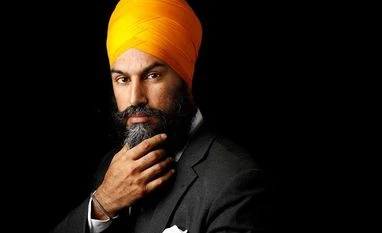 "Jagmeet Singh, the man who is the first non-white party leader in Canada")











