Kharif acreage twice last year's as monsoon covers India two weeks sooner

The monsoon coverage is fastest since 2013
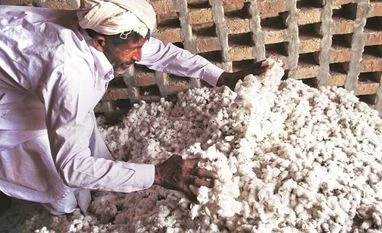
Cotton
Cotton was sown on around 7.16 million hectares till Friday versus just 2.70 million hectares a year ago
Sanjeeb Mukherjee New Delhi
2 min read Last Updated : Jun 27 2020 | 2:04 AM IST
The India Meteorological Department said on Friday that the southwest monsoon had covered the entire country, almost two weeks ahead of schedule. Thanks to the good rains so far, sowing of kharif crops, too, has picked up pace and area under cultivation was double the figure of the corresponding period last year.

Data from department of agriculture showed that kharif crops had been sown in around 31.56 million hectares till Friday, which was 104.25 per cent more than the same period last year. Acreage of almost all crops was higher than last year.

Data showed that even before the first month of the monsoon was over kharif crops had been sown in around 30 per cent of the area in which these crops are grown in the entire season.
Oilseeds were sown in around 8.33 million hectares till Friday, compared to 1.33 million hectares in the corresponding period last year. Pulses were sown in around 1.94 million hectares till Friday, as against 0.60 million hectares last year.

Cotton was sown in around 7.16 million hectares till Friday, compared to just 2.70 million hectares last year. Coarse cereals were planted in around 4.79 million hectares, as opposed to 2.44 million hectares last year.

The monsoon usually sets in over Kerala on June 1 and takes 45 days to reach Sri Ganganagar in west Rajasthan, its last outpost in the country.

Beginning this year, the IMD has advanced the onset date over Sri Ganganagar by a week and the new normal date for the monsoon to cover the country is July 8. “The southwest monsoon has further advanced into the remaining parts of Rajasthan, Haryana and Punjab and, thus, it has covered the entire country today, June 26,” the IMD said. A low-pressure area over the Bay of Bengal, which moved west-northwestwards, and another cyclonic circulation over central India helped advance the monsoon.

In 2013, the monsoon had covered the entire country on June 16. This had also coincided with the Uttarakhand flash floods.

IMD Director General Mrutyunjay Mohapatra said after 2013, it was only this year that the monsoon has advanced this rapidly.

One subscription. Two world-class reads.

Already subscribed? Log in

Subscribe to read the full story →
*Subscribe to Business Standard digital and get complimentary access to The New York Times

Smart Quarterly

₹900

3 Months

₹300/Month

SAVE 25%

Smart Essential

₹2,700

1 Year

₹225/Month

SAVE 46%
*Complimentary New York Times access for the 2nd year will be given after 12 months

Super Saver

₹3,900

2 Years

₹162/Month

Subscribe

Renews automatically, cancel anytime

Here’s what’s included in our digital subscription plans

Exclusive premium stories online

  • Over 30 premium stories daily, handpicked by our editors

Complimentary Access to The New York Times

  • News, Games, Cooking, Audio, Wirecutter & The Athletic

Business Standard Epaper

  • Digital replica of our daily newspaper — with options to read, save, and share

Curated Newsletters

  • Insights on markets, finance, politics, tech, and more delivered to your inbox

Market Analysis & Investment Insights

  • In-depth market analysis & insights with access to The Smart Investor

Archives

  • Repository of articles and publications dating back to 1997

Ad-free Reading

  • Uninterrupted reading experience with no advertisements

Seamless Access Across All Devices

  • Access Business Standard across devices — mobile, tablet, or PC, via web or app

Topics :Kharif cropsAgriculture productsIndian monsoon

Next Story



