The hours preceding the strike of cyclone Phailin, the strongest storm to hit India since 1999, saw the country undertaking the largest evacuation operation in its history. Before the landfall of the giant tropical storm, the Odisha administration had, on Saturday, shifted nearly 900,000 people to safer places - a sign that India was better prepared for a disaster this time than on any earlier occasion.
The country's best show before this was in 1990, when 650,000 people had been evacuated as a cyclone had hit Andhra Pradesh.
If the casualty figures, by which such natural disasters are often remembered, could be kept very low, it was all thanks to better planning and execution through a gigantic effort. It could have been this preparedness that prompted the state authorities to set a zero-casualty target before the cyclone struck the coast.
If the official death toll is anything to go by, that target has not been missed by much. According to state authorities, there have been 17 deaths so far - most of those due to falling of trees or rickety walls in the gusty wind before the cyclone reached the shores. In comparison, more than 10,000 lives had been lost in the 1999 super-cyclone.
"The human evacuation in 1999 was not even 10 per cent of that achieved this time," said an official associated with the cyclone mitigation operation.
The preparedness, running up to Phailin's arrival, could be called phenomenal. Since the first information about the approaching cyclone was received by the state five days back, the entire administration was seized of the matter, with the chief minister and chief secretary deliberating with senior officials and district administrations on the ways and means to tackle the impending calamity.
From October 9 to 12, on each day, two rounds of meetings were held at the state secretariat - one each chaired by the chief minister and the chief secretary. The secretaries of revenue, finance, water resources, energy, health, women & child welfare, panchayati raj, civil supplies & animal husbandry and special relief commissioner were also in attendance.
The government even cancelled its employees' Durga Puja holidays. Besides, the chief minister also took stock of the preparedness in vulnerable coastal districts, through video conferences, asking them to move people living in low-lying areas and kutcha houses to cyclone shelters, schools and other public institution buildings and to stock up enough relief material and essentials to meet the need of the distressed.
When reports would reach the headquarters that a few were not willing to leave their homes in coastal villages, the chief secretary would even order their forcible evacuation with the help of the police - a first in the state's pre-disaster operations.
With the intensity of the cyclone predicted to be one of the worst in recent times, the chief minister immediately contacted the defence ministry, which responded swiftly by sending army, navy and air force personnel, besides the teams of National Disaster Response Force, with requisite equipment to carry out relief & rescue operations, two days before the scheduled strike.
In a rare show of promptness the teams of central forces, which generally arrive at disaster-hit areas after calamities to carry out relief & rescue operations, were positioned at vulnerable points much before the cyclone struck, said a senior state official.
The administration's efforts were complemented by technology, too. Unlike in 1999, when the cyclone warning had come barely 48 hours before the catastrophe, allowing little reaction time to the government, there was a continuous flow of information since October 8 from the Bhubaneswar centre of the India Meteorological Department on the formation of the cyclonic storm in the Bay of Bengal, its intensification, progress path and landfall spot.
This not only helped the government build a defence system but alerted the people to take necessary precautions. In fact, the improved communication systems, aided by mobile penetration and 24x7 media coverage, also helped keep the damage and destruction at a low level, besides restricting human casualties. It might be fitting to say the country had learnt some important lessons from the 1999 disaster.
Apart from human efforts, the progress of the cyclone also helped. Unlike the 1999 super cyclone, which lay centred over the land mass for hours after hitting the coast, wreaking a large-scale havoc, Phailin weakened significantly soon after the landfall.

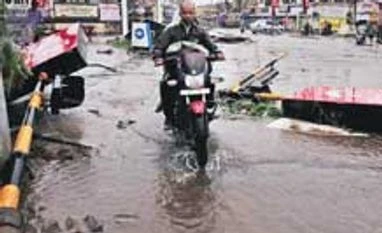 "Lesson from 1999 cyclone helped India tame Phailin")


 Connect with us on WhatsApp