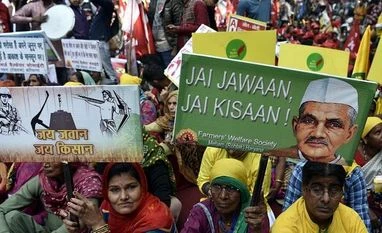
On the night of November 29, 2018, as many as 100,000 farmers from all over India arrived, via trains and tractors, in New Delhi, the country's capital. The next day, tens of thousands more marched to the parliament to draw the Central Government's attention to the deepening agrarian crisis and resulting farmer suicides.
Among other things, the farmers are asking for loan waivers and better prices for their produce.
The two-day long protest, called the Kishan Mukti March (Farmer's Freedom March), was led by the All India Kisan Sangharsh Coordination Committee (AIKSCC), a joint platform of about 150 farm organizations, formed in June 2017. A press release published on the website Dilli Chalo (Let's go to Delhi) explained that successive governments have failed to address the demands of millions of farmers. The group accused the authorities of ignoring the farmers’ plights, saying their apathy has turned into increasingly brutal antipathy.
The farmers’ charter of demands includes the passing of two bills in parliament, which have the potential to relieve their predicament — the Farmers’ Freedom from Indebtedness Bill, 2018, and the Farmers’ Right to Guaranteed Remunerative Minimum Support Prices for Agricultural Commodities Bill, 2018.
They also want the Minimum Support Price (MSP) — a form of market intervention by the government to insure agricultural producers against any sharp fall in farm prices — to be fixed at the market rate. The current MSP, as determined under the 2018-19 Union Budget, is 40 per cent less than the recommended price.
In a protest in March, 35,000 farmers walked 182 km — barefoot — from Nashik to Mumbai, to demand land rights and fair prices for their goods.
Over the past two decades, several hundred thousands of farmers have committed suicide in India. Suspected push factors include poverty, climate change, increased health costs (in the absence of insurance), and debt following failed harvests.
In solidarity, photographers started an innovative support campaign; hashtagging it #PhotographersForFarmers, they encouraged people to share images of the protests to raise awareness of the farmers’ challenges.
Apathy towards the agriculture sector
Nearly half of India's 1.3 billion people, especially in rural areas, work in the agriculture sector, though it contributes only about 17 per cent of the country's gross domestic product (GDP). Since 2014, during the tenure of the present government, India has witnessed a period of low food inflation, thanks to proactively managed food supplies and prices. However, the move also decreased rural incomes and burdened farmers with larger debts.
In a symbolic protest last month, Sanjay Sathe, an onion-grower from Nashik district in the western Indian state of Maharashtra, sent the sales proceeds from 750 kg of onions — at Indian Rs 1.40 per kg, this amounted to a mere Rs 1,064 (US$ 15) — to Prime Minister Narendra Modi's relief fund.
Increased costs of production
The prices of agricultural inputs have inflated over the past decade. The cost of items like chemicals and seeds, agricultural equipment — even labor — have all gone up.
Moreover, almost 60 per cent of farmers are selling their produce below the minimum selling price set by the government, which is not enough to cover their higher total input cost.
Hope amidst mounting debt?
With increased liability added to the mix, the situation has become untenable. Siddharth Tiwari, writing at Youth Ki Awaaz, explained:
According to the data from All India Debt and Investment Survey (AIDIS), more than 70% of the rural population has one or more standing loans. Decreasing farm income, the rising cost of production, and uncertainty of the market has led to the crippling debts in the farm sector.
Yet, in 2018, the farmers organized and successfully staged two big protests — and their most recent march attracted support from a few opposition party leaders.
The question remains, though: will any of this really change the future of India's farmers?

 "Massive farmers' march highlights India's apathy towards agriculture sector")











