MIT Profesor slams govt's Right To Education programme
Abhijit Vinayak Banerjee says that the programme lacks basic sense
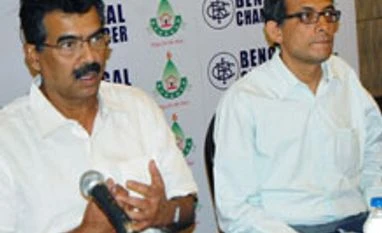
Digbijay Mishra Kolkata Abhijit Vinayak Banerjee, Ford Foundation International professor of economics at the Massachusetts Institute of Technology slammed the Right To Education programme by the government of India saying it is only a measure to ensure the livelihood of the teachers rather than addressing the real issue.
Banerjee rapped the programme implemented in 2009 by adding that it lacked basic sense and he is not very hopeful about the outcome of government's initiative.
"It is simply for the teachers by the teachers and of the teachers. It ensures the livelihood of school teacher from rising competition.” he said while addressing a seminar organized by Bengal Chamber of Commerce & Industry.
Banerjee argued in favour of 'Right to Learn' instead of the Right to Education (RTE) as the latter had missed to focus on all other issues in the education sphere and led to decline in teaching standards.
Annual Status Education report of 2012, quoted by Banerjee, indicated that 50% students in Class III could read Class-I level texts in schools, just over 40% were able to do so in 2012. In mathematics, it was worse. While 40% Class III students could do subtraction in 2009, around 25% students could manage to do it in 2012.
"Prior to 2009, the education level was flat. But there has been a perceptible decline after the RTE came into force. In RTE, there is a lot of emphasis on teacher-student ratio, teacher salary and physical infrastructure. Studies have shown no correlation between these factors and improvement in learning. On the other hand, it may force many schools to shut down as they cannot afford high salaries or huge infrastructure," the professor added.
According to Banerjee, the basic problem is every one runs after to complete syllabus and there is no mention of 'learning' in RTE which is a pointer to what is wrong with the legislation.
West Bengal Human Rights Commission chairman Justice Asok Kumar Ganguly termed it as a ploy by state governments who do not wish to see every child getting educated.
“The government schools are on the verge of closure as everyone runs to privately operated English medium schools. Education is the safest business. Today you have AC classrooms, AC buses and inordinately high fees. Private education has taken away access to education from a large section of the population," said Ganguly.

 "MIT Profesor slams govt's Right To Education programme")


 Connect with us on WhatsApp