Mysterious pink ice on Italian Alps sound alarm bells for climate change

Algae is not dangerous but shows the effect of climate change, say scientists.
Alps
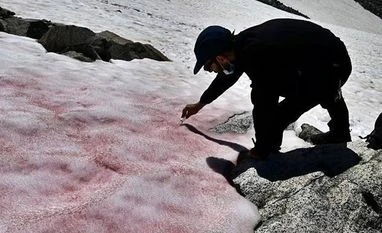
As the ice changes colour, it loses the ability to reflect heat meaning the glaciers are starting to melt faster. (Source: AFP)
BS Web Team New Delhi
2 min read Last Updated : Jul 09 2020 | 7:02 AM IST
The Alps have a new show: the appearance of pink glacial ice on the mountain range in Italy. Scientists say the colour is caused by an algae and could be a sign of how climate change is affecting the mountains. 

While there are debates about where the algae come from, "the pink snow observed on parts of the Presena glacier is likely caused by the same plant found in Greenland," Biagio Di Mauro of Italy’s National Research Council was quoted as saying by AFP. 

“The algae is not dangerous, it is a natural phenomenon that occurs during the spring and summer periods in the middle latitudes but also at the Poles,” Di Mauro added. 

Normally ice reflects more than 80% of the sun’s radiation back into the atmosphere, but as algae appear, they darken the ice so that it absorbs the heat and melts more quickly. The algae was first thought to be Ancylonema nordenskioeldii (a glacier alga), but Di Mauro clarified in a tweet that it is more likely to be Chlamydomonas nivalis (a snow alga).
Despite its rosy appearance, pink snow isn’t good news on the climate change front. (Source: AFP)

According to reports, tourists at the glacier lament the impact of climate change. “Overheating of the planet is a problem, the last thing we needed was algae,” said tourist Marta Durante to The Guardian.

More algae appear as the ice melts more rapidly, giving them vital water and air and adding red hues to the white ice at the Passo Gavia, altitude 2,618 metres (8,590 feet). “Everything that darkens the snow causes it to melt because it accelerates the absorption of radiation,” said Di Mauro. “We are trying to quantify the effect of other phenomena besides the human one on the overheating of the Earth,” said Di Mauro, noting that the presence of hikers and ski lifts could also have an impact on the algae.

The Alps are the highest and most extensive mountain range system that lies entirely in Europe and stretches approximately 1,200 kilometers across eight Alpine countries, France, Switzerland, Monaco, Italy, Liechtenstein, Austria, Germany, and Slovenia.

One subscription. Two world-class reads.

Already subscribed? Log in

Subscribe to read the full story →
*Subscribe to Business Standard digital and get complimentary access to The New York Times

Smart Quarterly

₹900

3 Months

₹300/Month

SAVE 25%

Smart Essential

₹2,700

1 Year

₹225/Month

SAVE 46%
*Complimentary New York Times access for the 2nd year will be given after 12 months

Super Saver

₹3,900

2 Years

₹162/Month

Subscribe

Renews automatically, cancel anytime

Here’s what’s included in our digital subscription plans

Exclusive premium stories online

  • Over 30 premium stories daily, handpicked by our editors

Complimentary Access to The New York Times

  • News, Games, Cooking, Audio, Wirecutter & The Athletic

Business Standard Epaper

  • Digital replica of our daily newspaper — with options to read, save, and share

Curated Newsletters

  • Insights on markets, finance, politics, tech, and more delivered to your inbox

Market Analysis & Investment Insights

  • In-depth market analysis & insights with access to The Smart Investor

Archives

  • Repository of articles and publications dating back to 1997

Ad-free Reading

  • Uninterrupted reading experience with no advertisements

Seamless Access Across All Devices

  • Access Business Standard across devices — mobile, tablet, or PC, via web or app

Topics :Climate ChangeFrench AlpsItaly

Next Story



