NGMA's Gadanayak has come a long way from a little village in Odisha

An open window, an open mind, open spaces and an open approach - Gadanayak, 54, passionately believes in them
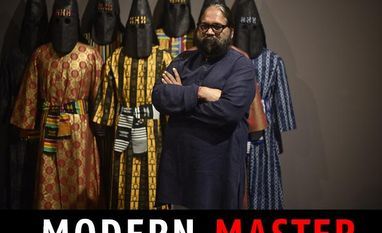
Adwaita Gadanayak
Adwaita Gadanayak, NGMA's first director general | Photo: Dalip Kumar
Veenu Sandhu
Last Updated : Jul 20 2018 | 10:58 PM IST
Neulapoi, a small village in Odisha’s Dhenkanal district, is flanked by the Kapilash temple dedicated to Shiva on one side and by the Mahima Gadi temple on the other. The Mahima followers do not believe in idol worship. Their god is the formless, shapeless Shunya Brahman. The two contrasting beliefs were part of Adwaita Gadanayak’s childhood in Neulapoi. And so were the myriad experiences of nature — the texture of trees and stones, the sound of water when you dunk your head in it, the look of rocks in the rains or when the sun burns down on them.

Life was a felt experience, which often found expression on the walls of the homes in his village. Everything connected to nature, even the manner in which the homes were built using the knowledge of the way air circulates so that they stayed cool in summer and warm in winter. His mother worshipped the elements. His father was a spiritual dancer who performed the ancient and demanding dand nacha, a ritual dating back to the Kalinga kingdom.

Gadanayak has come a long way from that village in Dhenkanal. And yet, in many ways, he has stayed connected with it, even while sitting in his office at the National Gallery of Modern Art (NGMA) in Delhi of which he is the first director general. (Before him, every NGMA, whether in Delhi, Mumbai or Bengaluru, had its own regional director.) He is still surrounded by art. The works — paintings, sculptors, etchings —created during a recent NGMA summer workshop are proudly, vibrantly on display. In his office, he moved furniture so that his chair now faces a window through which he can see the sky and the trees.

An open window, an open mind, open spaces and an open approach — Gadanayak, 54, passionately believes in them. “But my NGMA isn’t as open as it should be,” he says. “It looks like an intimidating government building, with its wall and railings and a guard at every gate.” Somewhere, somehow, it has lost its connection with people, just like people have lost their connection with nature and with art, he says. “It is both sad and frightening. NGMA has a wonderful collection of 18,000 artworks, but only a handful of people trickle in to see it. Even on opening nights, the same faces turn up.”

NGMA, India’s premier contemporary art gallery under the ministry of culture, is situated at the end of New Delhi’s Rajpath by the Central Hexagon around the bustling India Gate. The grand, butterfly-shaped building called Jaipur House is the former residence of the maharaja of Jaipur in Delhi. Every evening, hundreds of people come to India Gate to hang out at the war memorial, which has become a picnic spot of sorts. Sometimes Gadanayak goes and speaks with these people. “And they tell me art was something they were taught in school before they moved on,” he says. But there are also those times when he comes across somebody who has been to, say, the Tate Modern. “Their eyes light up when they talk about their visit to the Tate. It is as though it has added value to their bio data. My NGMA doesn’t give them that feeling.”

Gadanayak wants to change that. To begin with, he has extended the gallery’s closing time from 5 pm to 6.30 pm and hopes to push it further to 8 pm, at least on weekends. “Earlier, the guards would walk in at 4.45 pm and tell us to wrap up, even if a talk was on,” says a Delhi-based gallerist. “And five minutes past 5 pm, they would turn the lights off.”

The old building is currently being renovated and is expected to be ready in six months. It will also get better lighting. The idea is to make it more of an art piece itself so that more people are drawn to it. The cafeteria, too, is being redone. “I want it to be the kind of place where people might say to each other, ‘Let’s meet at NGMA’,” says Gadanayak.

He has also started the practice of art addas at the gallery on the last Friday of every month — reinstating a ritual of the 1950s and ’60s, when artists, scholars, curators, gallerists, filmmakers and writers would meet over tea to exchange ideas. “These sessions are open to all and are always packed,” says the gallerist.

This evening, NGMA will also host the second meeting of “Mitrum” (friends of NGMA), another of Gadanayak’s ideas to get people from diverse backgrounds to engage and collaborate with the gallery. These meetings are being held on the first and third Saturdays of every month. Efforts are also on to make the NGMA research library more vibrant.

On July 19, Gadanayak was in Kolkata where the 185-year-old Currency Building is being restored by the Archaeological Survey of India. It will house the Kolkata chapter of NGMA — the fourth after Delhi, Mumbai and Bengaluru.

When Gadanayak was chosen as NGMA’s director general in 2016, there was concern about ring-wing influence bearing down on the premier gallery. Gadanayak has served as the convenor of the Bharatiya Janata Party’s Odisha art and culture cell, something he is candid about. “My work as a sculptor is spiritual in nature. They [the BJP] perhaps connected with it,” he says.

Those in art circles say Gadanayak’s tenure so far has allayed those initial fears. “We have seen no attempt to sanitise the NGMA or push a certain agenda. On the contrary, things have improved,” says another respected gallerist. The NGMA has become far more accessible, works are being loaned from one branch to another and there are fewer bureaucratic hurdles.

Gadanayak has also turned the spotlight on non-A-listers —artists whose works are brilliant but whom the art market, auction houses and even NGMA haven’t paid attention to. The internally curated retrospective of Dhanraj Bhagat, one of India’s foremost sculptors, in February this year is an example of how well Gadanayak knows what he is doing. That a practising artist, and not a civil servant, is heading the institute is making a difference.

Gadanayak does not fit the description of the director of a high-profile institute in Lutyens’ Delhi, which still privileges members of a certain English-speaking power elite over others who may also have varied skill sets and long experience. On that count, he is an outsider.

As a sculptor who works with stone, he learnt early that working with a medium that hard means you first encounter tension. “It appears that you are fighting with it. After some time, you compromise with it. Then comes a stage when the stone becomes soft and as though merges with your skin. And then you both start working together, one guiding the other, collaborating,” he says. That’s what he wants to do — collaborate with artists, and institutes like the National School of Drama as well as schools.

Originally a science student, Gadanayak turned to art when his professor took him to an art college after seeing his remarkable drawings in zoology and botany. “I never knew something like an art college even existed,” laughs Gadanayak. The following year he joined the college in Bhubaneswar and later Delhi’s College of Art, from where he headed to the Slade College of Fine Arts in London. His interest in stone had developed during his visits to the quarries in Odisha.

He would later sculpt a statue of Gandhi’s Dandi March at Raj Ghat, work on the School of Sculpture at the Bhubaneswar-based Kalinga Institute of Industrial Technology University and collaborate with classical musician Pandit Jasraj to give form to one of his renditions. “Music is formless, sculpture is all about form,” says Gadanayak. The quest for form in the formless has remained a continuous influence.

Gadanayak has a studio at the Piramal Art Residency in Mumbai, where he has created some 200 sculptures, and another at Kaladham in Greater Noida. But he no longer gets the time to work as a sculptor. When not travelling, he is at the national gallery from 10 in the morning to past 9 at night. “NGMA,” he laughs, “is the sculpture I am now working on.”

One subscription. Two world-class reads.

Already subscribed? Log in

Subscribe to read the full story →
*Subscribe to Business Standard digital and get complimentary access to The New York Times

Smart Quarterly

₹900

3 Months

₹300/Month

SAVE 25%

Smart Essential

₹2,700

1 Year

₹225/Month

SAVE 46%
*Complimentary New York Times access for the 2nd year will be given after 12 months

Super Saver

₹3,900

2 Years

₹162/Month

Subscribe

Renews automatically, cancel anytime

Here’s what’s included in our digital subscription plans

Exclusive premium stories online

  • Over 30 premium stories daily, handpicked by our editors

Complimentary Access to The New York Times

  • News, Games, Cooking, Audio, Wirecutter & The Athletic

Business Standard Epaper

  • Digital replica of our daily newspaper — with options to read, save, and share

Curated Newsletters

  • Insights on markets, finance, politics, tech, and more delivered to your inbox

Market Analysis & Investment Insights

  • In-depth market analysis & insights with access to The Smart Investor

Archives

  • Repository of articles and publications dating back to 1997

Ad-free Reading

  • Uninterrupted reading experience with no advertisements

Seamless Access Across All Devices

  • Access Business Standard across devices — mobile, tablet, or PC, via web or app

Next Story


