The Supreme Court told the Uttar Pradesh government on Thursday that the vision document on protecting Taj Mahal, being prepared by School of Planning and Architecture (SPA), Delhi, should be made public once finalised as there is "nothing secret" about it.
A Bench of Justices Madan B Lokur, S Abdul Nazeer and Deepak Gupta was told by SPA that the process of preparing vision document would be completed within a "few days" and as per terms of reference they would submit it to the UP government.
"It (vision document) should be made public. It is a vision document. There is nothing secret about it. You place it on record also," the Bench told the counsel representing Uttar Pradesh.
Additional Solicitor General (ASG) A N S Nadkarni, appearing for the Centre, told the Bench that the first draft of the heritage plan for Taj Mahal, which is to be submitted to the UNESCO, was ready and it would be finalised within eight weeks.
He said that once the heritage plan is finalised, it will be sent to the United Nations Educational, Scientific and Cultural Organization (UNESCO) along with the vision document.
The Bench also dealt with the issue of declaring Agra as a heritage city and the Centre told the court that they had written to the UP government about it.
Advocate Aishwarya Bhati, representing Uttar Pradesh, told the Bench that they have sought assistance of Ahmedabad-based Centre for Environmental Planning and Technology, which would conduct a study on this.
When Bhati said it would take around 24 months to carry out the study, the Bench asked. "Why 24 months?".
She said in Ahmedabad, the entire city was not declared as heritage, and it took around eight to nine years to complete the process.
Professor Meenakshi Dhote, the project coordinator of vision document on Taj, told the court that they had received several feedbacks on vision document and her team would finish the work within the next few days.
The Bench also dealt with several pending applications, including those which have raised the issues of expansion of industries in Agra in contravention of the top court's order and construction activities and traffic congestion there.
The court told the applicant, who has raised the issue of expansion of industries, to approach the principal secretary of department of industries of Uttar Pradesh with his grievance.
The Bench has posted the matter for further hearing in the first week of February.
On September 25, the top court had extended till November 15 the time for Uttar Pradesh government to come out with vision document on protecting and preserving the 17th-century monument and asked it to consider declaring a portion of the area surrounding it 'heritage'.
The state government had said that "in-principle" there cannot be any objection in declaring all of Agra a heritage city but that would have several ramifications.
It had said it would be difficult to declare the entire city heritage but some portion of it could be brought within its ambit, covering sites like Taj Mahal, Fatehpur Sikri and Agra Fort.
The top court had earlier asked the authorities to take a larger perspective on issues of pollution and green cover while preparing a vision document, saying there would not get a "second chance" to preserve the Taj Mahal.
While observing that the Taj Mahal would "of course be the centrepiece" of the matters to be considered, the apex court had said other issues like vehicular traffic, pollution from the industries operating in the Taj Trapezium Zone (TTZ) and the water level of the Yamuna river should also be looked into while preparing the vision document.
The TTZ is an area of about 10,400 sq km spread over the districts of Agra, Firozabad, Mathura, Hathras and Etah in Uttar Pradesh and the Bharatpur district of Rajasthan.
Environmentalist M C Mehta, the petitioner in the case relating to protection of Taj Mahal, had told the apex court that green cover in the area has reduced and there were encroachments inside and outside the Yamuna flood plains.
The top court, which has been monitoring development in the TTZ area to protect the Taj, had earlier slammed the Centre, Uttar Pradesh government and TTZ authority for their failure to restore the pristine glory of Taj Mahal.

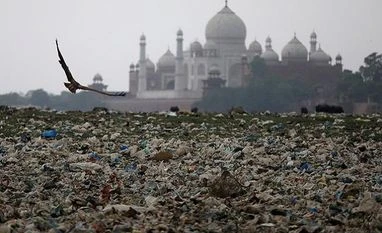 "Nothing secret about Taj Mahal vision doc, make it public: SC to UP govt")


 Connect with us on WhatsApp