PSLV-C20 launched successfully
Saral is first mission under Indian Mini Satellite Bus series-2, configured for 400 KG class satellite with miniaturisation techniques
Gireesh Babu Sriharikota
India’s Polar Satellite Launch Vehicle (PSLV)-C20 rocket carrying seven satellites, including the Indo-French satellite SARAL, blasted off today from the Satish Dhawan Space Centre in Sriharikota, Andhra Pradesh.
The ISRO-built SARAL is a 410-kg satellite with payloads — Argos and Altika — from French space agency CNES for enhancing the understanding of the ocean.
President Pranab Mukherjee, who watched the rocket’s launch, congratulated the Indian Space Research Organisation (Isro) for successfully executing the mission. Mukherjee today became the second president to watch a PSLV launch, after A P J Abdul Kalam did the same in 2005.
In his address to the scientists after the launch, Mukherjee said: "Challenges to our country today are many and they cannot be successfully countered without technology playing a pivotal roal in this effort." He said this was true in various aspects in a sustainable development paradigm, establishing a strong agriculture sector, respond to climate change, building rural sector, among others. Many of the government programmes such as the tele-education and telemedicine are reaching to the remote rural areas in the country with the help of technology and satellite, he added.
Isro started sending third-party satellites into the space for a fee in 1999 on its PSLV-C2 rocket. Since then, India has been successful in launching medium-weight satellites for overseas agencies. PSLV has an impeccable record of 21 consecutive successful flights. Today’s launch takes ISRO's tally of launching foreign satellites to 35.
Altika would help study the sea surface conditions, while Argos is a satellite-based data collection platform. The satellite will also be useful in tracking resident space objects, including space debris.
The six smaller payloads in the mission launched on Monday include two from Canada, two from Austria and one each from Denmark and UK.
Sapphire (148 Kg), a satellite built by MacDonald, Dettwiler and Association (MDA), Canada, is a space based optical sensor system aimed at an operationally acceptable space based surveillance to contribute to the US Space Surveillance Network (SSN).
NEOSSat (Near-Earth Object Surveillance Satellite) (74 kg) is built by Microsat Systems Canada Inc (MSCI). The Satellite has a space telescope dedicated for detecting and tracking asteroids and satellites in Geo-stationary orbit.
NLS 8.1 (UniBRITE) (14 Kg) and NLS 8.2 (BRITE) (14 Kg) are two scientific satellites launched and operated by Austria. UniBRITE is built for the University of Vienna with a mission to photometrically measure low-level oscillations and temperature variations in stars brighter than visual magnitude with unprecedented precision and temporal coverage not achievable through terestrial based methods, BRITE is similar to the UniBRITE spacecraft, with the expectation of the optical flter within the payload, which is used to observe the blue region of the light spectrum.
NLS 8.3 (AAUSAT3) (3Kg) is the third student cubesat from Aalborg University in Denmark, which has device for feasibility study of receiving AIS signals from ships in arctic regions and a Phoenix GPS receiver from DLR, Germany.
The vehicle also carried STRaND-1, the first satellite in the series of Surrey Training, Research and Nanosatellite Development programme, built by SSTL (Surrey Training Technology Ltd), UK, to fly state-of-the art technologies and new developments in low Earth orbit.
This is the ninth mission of ISRO using PSLV Core Alone variant (without solid strap-on motors). There had been 21 continuously successful flights of PSLV, till September 2012, according to ISRO.
The Space Research Organisation has launched its 100th mission on September 9, 2012, launching PSLV-C21 taking a French satellite Spot-6 and a Japanese student satellite Proiteres into space from Sriharikota. The missions include 62 satellites, 37 launch vehicles and one space capsule recovery experiment.

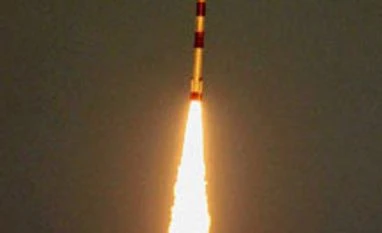 "PSLV-C20 launched successfully")


 Connect with us on WhatsApp