
Quad leaders meet in Tokyo, discuss Indo-Pacific region, global issues
Prime Minister Narendra Modi and leaders of the United States, Japan and Australia on Tuesday attended the second in-person meeting of Quad leaders in Tokyo
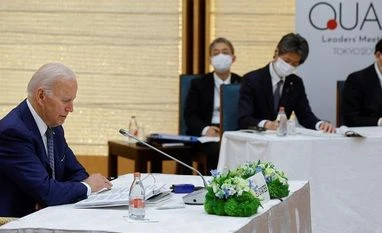 "Quad leaders meet in Tokyo, discuss Indo-Pacific region, global issues")
WebinarsNew
Deep DiveNew
Explore Business Standard
Prime Minister Narendra Modi and leaders of the United States, Japan and Australia on Tuesday attended the second in-person meeting of Quad leaders in Tokyo
Prime Minister Narendra Modi and leaders of the United States, Japan and Australia on Tuesday attended the second in-person meeting of Quad leaders here during which they are expected to exchange views about developments in the Indo-Pacific region and global issues of mutual interest.
The Quad or Quadrilateral Security Dialogue comprises India, the US, Japan and Australia.
Besides Modi, the Quad summit is being attended by US President Joe Biden, Japanese Prime Minister Fumio Kishida and Australia's newly-elected Prime Minister Anthony Albanese.
In a statement, before he left for Japan on Sunday, Modi had said the summit will provide an opportunity for the leaders to review the progress of the Quad initiatives and exchange views about developments in the Indo-Pacific region and global issues of mutual interest.
The summit is taking place under the shadow of the Russia-Ukraine conflict.
The Quad leaders are also set to discuss the Russian military offensive in Ukraine and the humanitarian as well as security implications of the conflict.
The summit is also taking place at a time when the relations between China and the Quad member countries have become tense, with Beijing increasingly challenging democratic values and resorting to coercive trade practices.
India, the US and several other world powers have been talking about the need to ensure a free, open and thriving Indo-Pacific in the backdrop of China's rising military manoeuvring in the region.
China claims nearly all of the disputed South China Sea, though Taiwan, the Philippines, Brunei, Malaysia and Vietnam all claim parts of it. Beijing has built artificial islands and military installations in the South China Sea.
On the eve of the summit, Biden on Monday launched the ambitious Indo-Pacific Economic Framework for Prosperity (IPEF), which is an initiative aimed at deeper cooperation among like-minded countries in areas such as clean energy, supply-chain resilience and digital trade.
The rollout of the IPEF is expected to send across a signal that the US is focused on pushing forward a strong economic policy for the region to counter China's aggressive strategy on trade in the region.
In March last year, President Biden hosted the first-ever summit of the Quad leaders in the virtual format that was followed by an in-person summit in Washington in September. The Quad leaders also held a virtual meeting in March.
In November 2017, India, Japan, the US and Australia gave shape to the long-pending proposal of setting up the Quad to develop a new strategy to keep the critical sea routes in the Indo-Pacific free of any influence, amidst China's growing military presence in the strategic region.
(Only the headline and picture of this report may have been reworked by the Business Standard staff; the rest of the content is auto-generated from a syndicated feed.)
First Published: May 24 2022 | 8:19 AM IST


 Connect with us on WhatsApp