Between 2001 and 2011, the number of rural households owning four-wheelers more than doubled to 4.4 million, the Socio Economic and Caste Census (SECC) 2011 showed. Automobile companies say the data partly reflect their success in penetrating the hinterlands of the country, as well as improved rural incomes.
According to data released by SECC 2011, 2.46 per cent of the 179.1 million rural households owned a four-wheeler, compared with 1.3 per cent, or 1.79 million households, in 2001.
Improving disposable income due to better farm yield and minimum support prices raised rural incomes significantly through the past several years. In addition to agriculture, rural-focused schemes such as the Mahatma Gandhi National Rural Employment Guarantee Scheme and the Pradhan Mantri Gram Sadak Yojna have led to improved incomes.
Still, less than three rural households in every 100 owned a four-wheeler, even as nearly three fourths (73 per cent) of the overall number of households in India are in rural areas, according to the SECC data. Rural regions, as defined by the central government, are places with a population of less than 5,000, a population density of less than 400/sq km and more than 25 per cent of the male working population is engaged in agriculture.
With such low vehicle penetration, passenger vehicle-making companies (car, sports utility vehicles and multi utility vehicles) have made a beeline for rural areas in the past few years. From organising car melas to setting up information kiosks and making the village sarpanch a salesman, car companies are leaving no stone unturned.
For car market leader Maruti Suzuki, the rural segment accounts for 31 per cent of its total sales, while for utility vehicle market leader Mahindra & Mahindra, it stands at 45 per cent. Foreign brands such as Hyundai have also aggressively pursued rural buyers, and this segment now accounts for 20 per cent of their sales.
Not only have rural buyers pushed carmakers to innovate on products suited for such markets, they have also provided a cushion against a slowdown in urban pockets, which have been under pressure since 2008. Vehicle household density in urban areas is under 10/1000, according to the study, much lower than the global average.
According to Tata Motors, car penetration in the rural market stands at a sixth of the urban market. Only three or four of every 1,000 own a car in rural regions, against 18 in urban areas, according to estimates by carmakers. The average car penetration in India is among the lowest for developing nations (for China, it is 69).
"We've studied the rural markets for passenger vehicles and feel these markets have the potential to contribute 35-40 per cent to the industry's sales. We want to be a part of this growth story. On an average, our rural sales account for 15-16 per cent on an annual basis. This year, we've challenged ourselves and are targeting 30 per cent," said a Tata Motors spokesperson.
"At the beginning of the year (FY14-15), we targeted to sell at least one vehicle in each of the 125,000 villages. We have been able to reach even the smallest of villages. Today, more than seven per cent of MSI (Maruti Suzuki India)'s sales come from villages with less than 200 households," R S Kalsi, executive director (marketing & sales), Maruti Suzuki India, had said recently. Car manufacturers are closely tracking the success of two-wheeler makers.
According to the SECC data, two-wheeler ownership saw a significant jump between 2001 and 2011 --- from 6.7 per cent of rural households owning a two-wheeler (motorcycle, moped or scooter), it has risen to 17.43 per cent. In absolute terms, 31.23 million households owned a two-wheeler in 2011, against 9.26 million in 2001. For two-wheeler market leader Hero MotoCorp, rural markets generate more than half its overall sales, while the figure is a lower for Bajaj Auto and Honda Motorcycle and Scooter India. The average sales for two-wheeler manufacturers from rural areas stand at 35-40 per cent.
While sales of motorcycles and mopeds have been robust, scooters are yet to penetrate rural areas significantly.

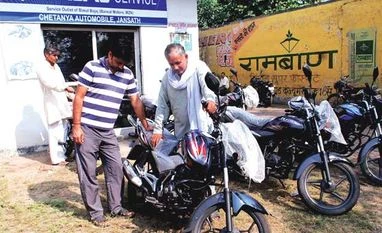 "Rural households with 4-wheelers doubled during 2001-2011")


 Connect with us on WhatsApp